Friday, June 27, 2008

Pandit Shyama Charan Shukla- an obituary


This obituary was written by my dad when Shyama Charan Shukla passed away in Chhattisgarh in February 2007. I came across it while surfing a news-site, posting it here.

Pandit Shyamacharan Shukla,the veteran of Congress politics of central India passed away 15 days back..

I am writing this just to share my experiences of interaction with the literally towering leader .I was taken to his Shankar Nagar(Khamardih) house by one of his non-political followers when I landed at Raipur from Kashmir after formation of Chhattisgarh.I was conducted into the inner room of the bungalow ,where Pandit Shukla was having his evening breakfast.Large number of his admirers and followers were in the hall .Pandit Shukla inquired about my background-Bihar and told about his Bihar connections too.

He offered me tea,which he prepared himself after inquiring about sugar quantity.He offered me fried items,like chana,daal,besan made sev etc.We discussed about Chhattisgarh politics for about 45 minutes.Since,the state was new,he told about the various leaders and their role in state politics.He was NOT at all critical of any leader and told about the importance of individual leaders.He told about the irrigation networking created during his chief ministership and suggested some ideas about how to develop the infant state.He talked about industrial potentialities and also agricultural growth of Chhattisgarh.He shared some of his experiences in Congress poltics-vis-a vis,Ms Sonia Gandhi.

He appeared to be an attentive listener too as he invited my ideas too.Pandit Shukla must have consumed three cups of tea from the Pot during the meeting.

What touched me most about Pandit Shukla was his gesture of coming out of his room to seem me off.He did not listen to my request to say good bye from the room itself.One may not believe,but he came to my car ,barefoot and left only after I was in the car and the engine was switched on.He was the tallest politician ,like Biju Patnaik.Like Bijubabu,Pandit Shukla has also great heart,he was hospitable like Bijubabu .

The greatness of the man who was thrice the chief minister of undivided Madhya Pradesh was evident in my first encounter itself.

Pandit Shukla could not get due from the party in the fag end of his life.His life could have been longer.He could not be appointed Governor of a state,though his name was in circulation for the last three years.He was Pandit in all respects. Late Rajiv Gandhi as prime minister had attended the funeral of Jagjivan Ram at his village in Ara and his petroleum minister,Chandrashekhar Singh at Munger.One was expecting, Soniaji's presence at the funeral of Pandit Shukla.

ends

Saturday, June 14, 2008

Patna Diary


Long time since I used my blog for news that was related to me. This can be attributed to what I call the "wheel of life" which i am witnessing right now, a phase which is characterized by the turning of wheels-when so much is happening yet you cannot say anything conclusively until the wheel stops.

Initially I planned to pursue MBA from Chandragupta Institute of Management, Patna (www.cimp.in) where i have been selected. I will be among the 60 students who maybe 4-5 years down the line will proudly say that we were the first batch of CIMP. The Pioneers! When I made up my mind of doing MBA in summer of 07, my mind was hovering around places like Delhi,Pune and Mumbai for these are the cities that houses some of the best business schools of India. And I candidly admit that Patna was not even in the wildest of my dreams.

The journey which started from the entrance test for IRMA went all the way to the exam for the NarseeMonjee and in between I made a brief stopover at CAT . I missed IRMA by 5 marks, Narsee by 7 and the CAT score left me with IMT(N) and score of other colleges which I can safely say were in the top 40.

But after the rest at CIMP which i though was the final abode, the wheels started spinning again and as of now a major part of my thought process is centered around doing MBA or Msc from Leeds University or University of Lancaster.

Only time will tell what the wheels hold..maybe Patna maybe Leeds!

Recently one of my college mate Roy got married to his child-hood sweet heart. He courted her for more than 8 years. Another of my friend Prashanth who is from Bangalore too is following the foot steps of Roy and after more than 7 years of a blissful relationship with a girl from Bhopal for more than 7 years is finally getting married on the 25th of June.

Good things happen to good people.May god be as kind to all of us who fall in the category of Roy and Prashanth as he has been to them.

Adieu

Friday, June 06, 2008

Chhattisgarh political analysis May

With the final count-down for the ensuing Assembly elections starts in Chhattisgarh, Congressmen in the state rally behind the unity mantra to take on the rallies of Chief Minister Dr Raman Singh.

May 23 will have a great significance when the new government will assume office later in the month of December this year. For, it was on this day the ruling Bharatiya Janata Party (BJP) launched a Gujarat-model of Yatra to retain power while opposition Congress went for a major overhaul in the party model to prepare for the coming polls.

Dr Singh launched his Vikas Yatra (road show) to propel the party workers in election mode from the headquarters of worst-Maoist hit Dantewada district. Leader of Opposition and BJP’s Prime Minister candidate L K Advani along with state polls in-charge Ravishankar Prasad were specially present to flag off the Yatra

During his six-phased Yatra, Dr Singh is scheduled to address as many as 1,200 public meetings and rallies in the 90 assembly constituencies of the state. “I want to directly interact with the people. And it is not possible by flying in a chopper,” Dr Singh said while explaining about the motive of his road show.

But the road show of the chief minister is guided more by the Gujarat formula than the local one. The Vikas Rath (Chariot) is reported to be the same in which Gujarat Chief Minister Narendra Modi covered the length and breadth of his state before the elections that rode him back to power. The Rath has been redesigned according to the taste of Dr Singh and the state. But the strategy and the mechanism of Gujarat model remain the same.

While the “Sarthi (driver)” of Modi’s Rath is driving Dr Singh’s chariot, the motor mechanics to take care of technical snags have also come from Gujarat. The message is clear—the driver is guiding the road as he did in Gujarat while the mechanics are here to rectify the technical snags if coming in its way to stop Raman Singh for taking his party to retain power in the state.

The Gujarat model is certainly in action and the master-strategists of the ruling party are selling the development theory as it worked in Gujarat to convince people that Chhattisgarh has seen a new phase of development after the BJP government assumed office in December 2003.

The only difference between Chhattisgarh and Gujarat is that, Dr Singh avoids taking a drive in the pockets that reel under one of the biggest problems the state is facing from the Maoists. Though Dr Singh started his Yatra from Dantewada, he missed to attend a single rally--contrary to the claim that he will hold meetings in each assembly constituency—in worst Maoist-hit Konta and Bijapur Assembly segments in Bastar.

Dr Singh took the roads that did not pass from the territories that red army claims to be theirs and under its influence. While he successfully completed his Yatra in Maoist-hotbed of Bastar region, the Chief Minister’s convoy passed through the National Highway or main roads instead of going to the interior areas where he could get the exact picture of his Vikas Mantra.

“Since there is no Vikas (development) in the Maoist-hit areas, the Vikas Yatra of the chief minister missed to roll in the interior areas,” a senior leader of the ruling party quipped. The BJP strategists are confident that it will not have much impact as only five to six seats can be categorised as under the influence of the rebels. But the BJP leaders failed to count the rebels had their presence in the tribals pockets and in the House of 90, the 29 seats reserved for the Scheduled Tribes (ST) holds the key to power.

The opposition party however committed another mistake by failing to acknowledge the importance of 29 tribal seats in the state while appointing a politically low-profiled Dhanendra Sahu as the new President of the Chhattisgarh Pradesh Congress Committee. “A tribal party chief in the state could have been a better bet,” said a senior Congress leader from the state.

The move of giving big onus to Dhanendra, a sitting Congress legislator, is to rig the Sahu votes that also play important role in changing the political equation of electoral politics in the state. In the move to sway the other backward class, Charandas Mahant has been retained as working President of the PCC—a demotion of post as he earlier held the post of state party chief.

Another Congress legislator and a Brahmin face of the Congress in Chhattisgarh, Satyanarayan Sharma has also been appointed as working president of the party. Sharma in fact has a capacity to propel the party workers to take on challenges, his election strategies in by-elections in the state has yielded the desired results for the party.

The Congressmen in the state have rallied behind the unity mantra in the new party organisational set up. A massive welcome rally in the state capital on May 29 with senior leaders of all factions on board the Ekta Rath demonstrating unity has charged the party workers. But the unity under a single leadership and now a series of leaders could help the party in better way.

Now with Karnataka going away from the Congress, it has become clear that the failure of party to project chief minister’s candidate has given advantage to the opponent. A high time, Congress should think of a one in 
Chhattisgarh and other states that go to the polls later in the year.

Madhya Pradesh political analysis May

On the one hand the ruling Bharatiya Janata Party (BJP) has swung into election mode by attacking on Congress led UPA, while on the other the state Congress has hardly got its campaign off the ground. Over the past one week, Chief Minister Shivraj Singh Chouhan and the BJP have been busy attacking the Centre on price rise, and an alleged supply of substandard wheat and several other issues.

The BJP election in-charge for MP, Venkaiah Naidu has made it clear to party workers in no ambigious term that corrupt image is something the party would just not tolerate. Naidu has time and again cited the precedence of Gujarat where the clean image of the government and its developmental agenda won it assembly polls hands down and he has reiterated that the party would not want to compromise on the formula.

This new ‘clean-image’ formula took its first toll on Health Minister Ajay Vishnoi after he was asked by the BJP central leadership to resign after his brother’s premises was raided by the Income Tax Deprtment in the wake of alleged medicine purchase scam by the state health department.

More heads could roll as three present ministers of the cabinet have been charged with allegedly demanding donations from state officials. This include forest minister Kunwar Vijay Shah, Minister of state Harendejeet Singh `Babbu’ and Fisheries minister Moti Kashyap. In all the cases the complainer has been government servants and bureaucrats.

According to sources a list is being chalked out to ensure that the `tainted’ faces are distanced from the government as soon as possible so that by the time the electioneering is at peak, the negative impact of these ministers are dulled. Many of the sitting MLAs are also sure to lose tickets, but the tainted ministers are naturally on top of the agenda.

Rumors have it that at least three ministers might soon be dropped from the state cabinet and the one facing the sharpest axe is revenue minister Kamal Patel. Six ministers have reportedly being listed as liability on clean image of government but the proximity of three of them to the senior leaders in Delhi might save the day for them.In such situation, the party is likely to take some stern steps to distance itself from the black sheep and give its best shot at winning the second consecutive term in MP.

The speculation that Uma Bharti would soon make a comeback to BJP was finally laid to rest after BJP Prime Ministerial candidate L K Advani personally managed to thwart the proposal of re-entry of the firebrand leader into the party folds, putting such conditions that would certainly be rejected by the former MP Chief Minister.

During a high level core committee meeting, Advani overruled party president Rajnath Singh’s proposal to let Uma Bharti return.The party stalwart – who was instrumental in mentoring Bharti into a national leader – insisted that Uma could return only on condition of forgetting Madhya Pradesh politics and providing consent of contesting next Lok Sabha election from Uttar Pradesh.

Advani is upset that Uma, who was sacked from party for indiscipline, has not mended her ways and continues to attack leaders like Arun Jaitley and Sushma Swaraj. Rajnath’s interest in getting Uma back was to build a strong counter force to the second generation leaders, but failing to marshal enough support in the core committee, he decided to forget the proposition for the time being.

Bihar Political Analysis May

PATNA:The 30 –months-old NDA government in Bihar faces crisis for its survival due to differences within the alliance. The recent attack on a senior BJP legislator, Phalguni Prasad Yadav, at Chakai in Jamui district by the food minister, Narendra Kumar Singh, in a public meeting has once again exposed the rift between the two partners of the NDA in Bihar.

In an earlier incident the then culture and sports minister, Janardan Singh Segriwal,a senior BJP leader was publicly humiliated by a Janata Dal(U) legislator, Rampravesh Rai, in the minister’s constituency. The minister was insulted by the Janata Dal(U) legislator on the high-way.

The BJP legislators are agitated as they feel they are being treated as number two in the NDA government. They feel that the chief minister, Nitish Kumar, has done nothing to control his party legislators and leaders who have time and again acted against the BJP. Narendra Kumar Singh is senior to Kumar in the politics and had been involved in many controversies in the past too. In November 2,005, he had assaulted a magistrate on duty at the assembly gate as the magistrate wanted his identity card. Last year, he assaulted an old woman at Sabour Agriculture University, where the woman had gone to seek job for his son.

The minister and the BJP MLA, Phalguni Prasad Yadav, were sharing the dais for an official function at Chakai. Later the minister pushed the legislator and he fell down from the dais and fractured his leg. The BJP legislators have complained about the matter to senior leaders in Delhi and their legislature party leader, Sushil Kumar Modi, who is himself facing rebellion in the BJP for “mortgaging” the party to the Janata Dal(U).

The BJP legislators are seeking his removal as they feel that it is due to him that JD(U) which was a smaller party than BJP in Bihar has now overgrown BJP. The rebels have been out in the open ever since the cabinet reshuffle took place and they allege that Modi has always used his proximity to party president Rajnath Singh and general secretary Arun Jaitley to quiet any dissent in the party.

Earlier the rebels were confined to the in-house discussions but this time it appears that the nearly two dozens legislatures have decided to go for an all out war. The fact that Portfolios of two senior party leaders Nand Kishore Yadav and Ashwini Chaubey were changed has given fuel to the fire and it would require more than political acumen on the part of Modi to douse this fire.

The state BJP is also apprehensive that in the next general election it would be the JD(U) that will win hands down as all the credit of the work being undertaken in the state has the stamp of Nitish Kumar in it and he has successfully managed to portray himself as the face of the present government. This has led to the fear among the party legislatures that BJP would be reduced to a non-entity in the next election. And they feel that’s it’s Modi who is responsible for this as according to them Modi has promoted himself, not the party.

Saturday, May 03, 2008

Madhya Pradesh Analysis April


The Betul by-election outcome is likely to make a deep impact on the assembly elections scheduled in November this year. Buoyed by Betul result, Chief Minister Shivraj Singh Chouhan is likely to have a greater say in the future ticket distribution. The results have given the Chief Minister a greater say in preparing ground for the assembly elections.

BJP candidate Hemant Khandelwal polled a total of 3, 00,674 votes against 2, 65,234 scored by Sukhdev Panse from Congress, a sitting MLA. After the recent defeat of BJP in Khargone Lok Sabha and Shivpuri, Sanwer and Lanjhi assembly by-elections, the party candidate emerging triumph in Betul has provided the much needed relief to its workers.

After the Betul result, ministers in whose constituencies, the party was defeated might face some hard questions. Informed sources feel that in the event of poor showing by BJP, Chouhan would have been dependent upon party leadership and high command for working out strategies for forthcoming assembly elections but now his recommendations and views would find bigger space in the next round of assembly elections.

Though the BJP emerged triumphed in Betul still it lost two assembly segments Harda and Masaud which analyst feel is an indication that the ruling party is losing base in these segments.

Chindwara warhorse and Union commerce minister Kamal Nath has reasons to feel low these days. Firstly his candidate for the Rajya Sabha Seat, Vivek Tankha was not able to make into the upper house despite Kamalnath putting his best efforts and then came the Betul result.

Betul verdict came as a big blow to Kamal Nath as he had camped in Betul for a long time and campaigned extensively in favour of Congress candidate Sukhdev Panse. Sources close to Kamal Nath have suggested that he is blaming party colleague and state PCC chief Suresh Pachori among others for the debacle in Betul as he feels that the state Congress body was more interested in Kamal Nath losing his face than Sukhdev Panse winning. It must be also added that senior Congress functionaries had cautioned Kamalnath that Betul would be a tough nut and he should not waste his force there.

BJP won the Betul seat for the fifth time in a row. Congress during the campaigning had paraded its MPs Sachin Pilot and Priya Dutt besides AICC Secretary Jitin Prasad while BJP relied on party president Rajnath Singh to emerge winner.

Betul has always been a saffron bastion and the Congress has emerged victorious on only two previous occasions. Fist when the whole of India was experiencing the Indira wave and the second when the Congress was riding on popularity of Rajiv Gandhi.

The inner discontent that had emerged in the party ever since Suresh Pachori took over as the new state PCC chief has now lost some of its steam. This has been possible after every major faction was given a representation in various local Congress bodies. This has given Pachori much needed time to concentrate on other important matters like working on the groundwork for the assembly elections.

The state PCC is focusing on spreading UPAs achievement among the electorate in the state. Pachori has asked the workers to highlight achievement like 27 percent quota in educational institutions and setting up of first of its kind 'tribal university' in Amarkantak among the voters. The PCC is also working on the lines of linking both these ‘achievements’ to Arjun Singh , as they feel that this will increase the benefits as Arjun Singh is from Madhya Pradesh.

With only six-months in hand Bharatiya Janata Party has established an election cell in the state party headquarters under Anil Dave, state BJP vice president who has been appointed in-charge of the cell.

The BJP meanwhile launched the ambitious the state-level Mukhya Mantri Annapurna Yojana which would provide subsidized food grains to BPL families. Under this scheme, each BPL family (holder of blue ration card) would be provided 20 kilogramme food grains per month. Wheat would be provided at the rate of Rs three per kg and rice at the rate of Rs 4.50 per kg from ration shops.

The party had launched a similar program in the neighboring state of Chhattsigarh with much funfair. In the past two-years, ruling BJP Government has launched various people oriented welfare schemes in the State including 50 per cent reservation to women in Gram Panchayat level and ‘Ladli Laxmi Yojna’. Needless to say the forthcoming elections are playing on the minds of both the BJP and Congress, and both are leaving no stone unturned to woo the voters.

Bihar political Analysis April

The long awaited cabinet reshuffle in Bihar has threatened to turn into a major headache for both the JD (U) and BJP. The shuffle was being awaited for the last 2 and a half years by the legislatures and their supporters from both the coalition partner and when now it has finally occurred it has led to growing tensions in BJP and JD(U).

Chief Minister Nitish Kumar replaced ten members of his Cabinet and added 19 new faces. Eight leaders from the Janata Dal (U) and two ministers from the Bhartiya Janata Party (BJP) were asked to resign from their ministership on ground of 'less than satisfactory performance'.

The state BJP is facing its first major problem since time immemorial. Angry protests and voice of dissent among the supporters of those leaders who were dropped from the cabinet including former Sports, Art & Culture Minister Janardan Singh Sigriwal and former Health Minister Chandramohan Rai has forced the BJP headquarters in Delhi to intervene.

Former ministers and their supporters are pressing for the removal of Deputy CM Sushil Modi and party state president Radha Mohan Singh. The removal of Chandramohan Rai has caused the most resentment as he is a very senior leader and had done quite well when he was in charge of the Health ministry.

The disgruntled leaders of BJP are blaming Modi of practicing autocratic culture and have alleged that he is doing all he can to stop any other party leader from gaining roots. The vociferous protests forced the BJP to summon Modi twice to Delhi in order to work out some solution. Kalraj Mishra, the Bhartiya Janata Party (BJP) general secretary and party in-charge of Bihar was also rushed to Patna to calm the protestors but he was not able to make any headway.

Though reports coming from within the party suggest that Modi has been given a breather till the Karnataka polls and the dissenters have been told that their issues will be sorted out after the polls in Karnataka and till then they have been asked to cooperate with the new ministers and avoid using media to voice their anger.

It’s not that JD (U) hasn’t developed any fissures post reshuffle but Nitish Kumar has been able to quell any such protest within the JD (U) only because he is a much taller leader than Modi. No other leader in the state JD (U) can match the political credentials of Nitish. Unfortunately the same cannot be said about Modi who though is experienced yet is young when it comes to some of the senior state BJP leaders. And it’s these leaders that have let it know to the party High command that they are being felt led down and their long standing loyalty is being ignored.

In between all the recent political development it seems that “Development of Bihar” has taken a back seat. 

Although Nitish Kumar has categorically said that development of Bihar will still be the main emphasis of the present state government but it’s anyone guess that with clashes of so many political aspirations and ambitions, how long the social and economic development of Bihar will continue to be the primary focus.

Tuesday, April 01, 2008

Chhattisgarh political analysis- March 2008

The Bharatiya Janata Party (BJP) government in Chhattisgarh is confident of retaining power but the party high command doesn’t seem to share the same enthusiasm.

The appointment of senior BJP leader and master strategist Ravishankar Prasad as the in-charge of election affairs in the poll-bound Chhattisgarh is reported to be an overt signal that the party high command is hesitating to buy the assurance of the state leaders that all roads are leading to the BJP retaining the power in the state.

Chhattisgarh is scheduled to go to the state polls in November-December. The biggest challenge for the saffron brigade is to win the confidence of the voters to continue with the second spell in power in the tribal-dominated state. The state BJP leadership is expressing confidence of winning the electoral battle in the state for two reasons.

First, the development works that it has initiated in the state alongwith the government sponsored scheme of selling a kilogram of rice for just Rs 3 to over 3.4 million families living below poverty line has resulted in a high-increase in the vote bank.

Secondly, the BJP is hoping that the fractured opposition in the state due to the infighting in Congress following severe differences in its ranks and files will help BJP in consolidating in areas which traditionally have been Congress bastion.

Prasad’s taking over the command to propel and prepare the party cadre to the ensuing elections is seen as a major political development. The state already has a national general-secretary, Dharmendra Pradhan, as an in-charge of party affairs in the state. By bestowing onus to senior leader like Prasad, the BJP high command has send a clear signal that the election in Chhattisgarh is not a cake walk as the local leaders have been projecting.

The leaders in Chhattisgarh have reasons to play the development down. “The party high command has appointment in-charge in all the states that will go to the polls,” explained a senior BJP leader. But the leader failed to address why heavy-weight leader like Prasad has been given the responsibility of one state when Venkaiah Naidu is doing the same job for two states—Rajasthan and Madhya Pradesh, which comparatively are bigger states than Chattisgarh.

According to party insiders, the party is of the opinion that elections in Chhattisgarh and Karnataka has to be handled with more importance. That could be the reason why Prasad has been given the responsibility of Chhattisgarh state so that he could fully concentrate in one state while assigning Arun Jaitley to Karnataka.

Prasad landed in the state on his 3 day maiden visit on March 27. During his stay, he tried talking to different groups and get the pulse of the general feeling in the party circle. In the absence of Chief Minister Dr Raman Singh, he chaired the meeting of core group and interacted with the senior members. His one-to-one meeting with ministers and legislators provided him more information was seen as an effort to get the exact picture of the government and party organization.

Although the Bihar political stalwart gave clean chit to the Chief Minister and reiterated his party President Rajnath Singh’s stand that the state will go to the polls under Dr Raman Singh’s leadership, Prasad knows that much is needed to done if the party has to emerge victorious.

Prasad will also have to work hard to reduce the rift that has been created between the Rashtriya Swayamsevak Sangh (RSS) cadre and the government. RSS alleges that its suggestion are not being heeded by the state government.

Amidst resentment against the government and organization at the ground level, ticket distribution will be another daunting task for the party’s election in-charge for the state. Prasad has already hinted that getting a ticket to contest the polls on BJP ticket will not be as easy as he will scan each leader including the sitting legislators before the list is finalized.

Prasad has already indicated his stand on the matter to all the leaders waiting in line to enter the Chhattisgarh Vidhan Sabha. A former Congress leader, who crossed over to the BJP and enjoys a good support among the Oriya voters, came with a big crowd to meet Prasad at the state guesthouse. As his supporters raised slogan, Prasad responded: “Shouting slogans will not ensure party ticket. One has to do good work”.

Madhya Pradesh political analysis-March 2008

Bharatiya Janata Party emerged victorious on all the three Rajya Sabha seats from Madhya Pradesh in a biennial RS polls held here. All the three contestants of the BJP, Raghunandan Sharma, Prabhat Jha and Maya Singh emerged victorious by securing 58 votes each. Independent candidate Vivek Tankha, who had the support of Congress and the Samajwadi legislature, was defeated as he could muster only 51 votes.

Earlier the political atmosphere in Madhya Pradesh witnessed hectic activity in view of the impending Rajya Sabha elections. After a lot of deliberations and meeting the BJP was finally able to arrive at a consensus on the name of BJP Vice President and its Mahila Morcha state in charge Maya Singh, senior leader Raghunandan Singh a former renegade who was wooed back into the BJP from the BJS and Secretary Prabhat Jha who was the editor of party mouthpiece ‘Kamal Sandesh’.

Samajwadi Party MLA from Lanjhi constituency Kishore Samrite caused a flutter when he accused the Congress leaders including PCC chief Suresh Pachori of offering him bribe so as to vote in favour of independent candidate Vivek Tankha. Samrite was later suspended from the party.

Tankha who was earlier Advocate general when the Congress was in power under Digvijay Singh, claimed to have the support of the other smaller parties like the SP and the GGP. It’s no secret that the whole election management of Tankha was being managed and supervised by Union Minister of Commerce Kamal Nath.

The state is going to witness another bypoll which is scheduled to be held on the 12th of April. The Betul bypoll was necessitated due to the death of BJP MP Vijay Kumar Khandelwal. Congress is being represented by Sukhdev Panse who also represents Masod in the Assembly. BJP has given ticket to Hemant Khandelwal who is the son of Vijay Khandelwal. Dr.Sunilam, president of the state unit of the Samajwadi Party and MLA from one of the assembly segments-Multai, has also filed his papers for the Betul seat.

Betul will be the last election before the assembly polls and all the parties have mounted their efforts to emerge victorious and go into poll mode with a positive outlook. BJP has pitched in eight ministers who have been made in-charge of separate assembly segments of the Betul Lok Sabha constituency. Recently Chief Minister Shivraj Singh Chouhan visited Betul twice and announced attractive sops for them including construction work of more than Rs 100 crore.

Congress goes into the poll with two wins under its belt including victories in Khargone Lok Sabha and Sanver assembly bypolls.

Many of the high profile candidates who were trying for a ticket form Betul including former MP Ghufran-e-Azam, Aslam Sher Khan, NSUI president Hemant Vagdare and Nakul Nath, son Kamalnath were left disappointed. Though sources close to Kamalnath have suggested that he decided to pull out the race as he wanted to play safe and plans to launch his son in the next assembly elections which are just eight months away from Chindwaara which has been his bastion for more than 20 years

Political pundits have already termed the Boston University graduate Nakul Nath, who recently joined the party as a potential challenge to Jyotiraditya Scindia and Arjun Singh’s son Ajay Singh. Ajay Singh was recently appointed Election campaign in-charge to the run-up to the state election.

The newly appointed state PCC chief Suresh Pachori got a glimpse of the tough times that is expected from the party cadre when PCC general secretary and spokesperson Manak Agrawal vacated his office situated in the state congress building in a huff. This was after Manak found his name missing in the list of the newly declared executive committee comprising 12 vice presidents, 17 general secretaries, 1 treasurer, 26 secretaries, and 50 working committee members.

After Manak it was the turn of Gufran-e-Azam, who resigned from PCC state executive as a member. The issue has threatened to turn into a major embarrassment for Pachori after Madhya Pradesh Congress legislator and Vice president of State Congress Committee Arif Aqeel lambasted Gufran-e-Azam’s resignation.

Gufran-e-azam in recent years has lost more political weight than he has gained. Azam at the time of Digvijay singh had a strong political clout and was considered close to Sonia Gandhi but with the emergence of other leaders belonging to the minority section in the capital like Areef Aqeel and his inability to make an impact on the electorate has led to his stature has being reduced.

It has also been reported from some quarters that the BJP is making efforts to get firebrand leader Uma Bharati back into the party. The move, notwithstanding opposition from certain sections within the party, has gained ground with the assessment that the firebrand leader, who is currently running her own outfit, the Bhartiya Jana Shakti (BJS), might cut BJP’s votes in the October/November polls if she does not get back into the party-fold.

In the first step towards by any party in furtherance to the state assembly election, BSP became the first party in the state to declare it candidates for assembly elections that are eight months away. The BSP has decided to apply the same successful formula of social engineering that was instrumental in its victory in Uttar Pradesh. Mayawati led BSP announced the party candidates for 62 seats and not surprisingly the maximum number of seats have been allotted to Brahmins followed by the Rajputs and the OBCs.

Friday, March 28, 2008

Naxals turning Urban


Recent developments have suggested that the intellectuals supporting the Naxal revolution in India are working on devising a strategy to demand the status of ‘Political prisoners’ for the naxals that have been captured and arrested.

Recently villagers comprising of women and young girls from Bihar, orissa, Chhattisgarh, West Bengal and Jharkhand, staged a demonstration near Jharkhand Chief Minister Madhu Koda’s residence in Ranchi demanding that arrested Naxalites be treated as political prisoners. Earlier, they had organized a march at Jharkhand Raj Bhavan seeking political prisoner status for the detained Maoists.

The general definition of a political prisoner is someone who is imprisoned because of their political views.

The Maoist calls themselves the beacon of the landless and the poor, and pride themselves in waging a struggle for the uplift-ment of the common mass. The same naxalites raid and kill security personnel in cold blood. 

If the naxalites who are accused of killing innocent villagers, political activists and policemen are awarded the status of political prisoners then they would be in the distinguished company of Nelson Mandela, Mahatma Gandhi, Fidel Castro, former president of South Korea Kim Dae Jung , Myanmari poet and journalist U Win Tin , who at some point of time in their life were all termed as political prisoners and imprisoned.

These leaders waged a ‘war’ that was based on non-violence and drew its strength from protests that were displayed by way of speeches, writing and non-cooperation. Does the same thing hold true for a hardcore Maoist?

International organization like Amnesty International campaigns for the release of prisoners of conscience or POCs, which include both political prisoners as well as those imprisoned for their religious or philosophical beliefs. But as a matter of principle, the organization's policy is to work only for prisoners who have not committed or advocated violence.

Political prisoners have never been associated with violence against the un-armed. They are the exponent of democracy and civil rights. Can the same thing be said about the Maoist?

The red bastion that they have managed to establish in states like Chhattisgarh and Andhra Pradesh stands testimony to the kind of violence they propagate.

Chhattisgarh is at present the worst hit by Maoist activities. The affected area is Bastar in southern Chhattisgarh, comprising five districts. Kanker (northern Bastar), Bastar (Jagdalpur), Dantewada (southern Bastar), Bijapur and Narayanpur combined together add to 39,000 sq km, a area that is little larger than Kerala and a little smaller than Haryana.

The pathetic and callous attitude of the successive state government in various states towards the development of backward areas has contributed in no small way in the spread of the naxal movement from 1967 when it was first started in Naxalbari in West Bengal.

Even now the answer to eradicating this menace does not lie in the brutal use of force but a strategy that is based on pushing the agenda of socio-economic development in the rural and remote areas. Generating employment opportunity, which is resented by the naxals, will go a long way in dissuading more young legs in joining the movement.

On the other hand excessive use of force will make wounds more deep. Salva Judum campaign in Chhattisgarh has forced the villagers to take side; either they are with the Judum supporters or they are naxalites supporters.

Earlier in 2007 the home ministry came under intense pressure to act against several serving and retired bureaucrats and academics after receiving reports that they were propagating naxalism at a seminar in Delhi.

The report, drawn up by home ministry officials, said the seminar which was held in campus of a university in Delhi had a “pro-Naxalite” theme. The participants engaged themselves in “anti-state” discussions that seemed to justify armed uprising. But a “top-level intervention” stopped the Home ministry from taking any action.

Recently an arms-making-cum-R&D unit of the Maoists was un-earthed in Bhopal. A similar arms-making unit was busted in Rourkela, Orissa. These new development should not be taken as stray incidents but they are a sign of a much larger plan. Now the naxalites are encouraging even the bourgeois and the affluent class to join them. Earlier the membership to their organization was strictly limited to the strata coming from low and poor economic background.

In Nandigram, a fact finding committee has established that the maoist were responsible for inciting the violence in Nandigram and singur.

A report submitted by the West Bengal CM, Buddhadeb Bhattacharya to the Manmohan Singh on the Nandirgam violence has blamed the left wing extremist for the flare up in violence. The report says “It may be noted that Left wing extremists (LWE) have stepped up their propaganda pertaining to the espousal of the causes of farmers by raising the issue of displacement of farmers from their own land for industrial and infrastructural projects. Frontal organizations of LWE activists named the Gana Pratirodh Manch carried out propaganda against the acquisition of land in Singur and have also generally opposed land acquisition for large projects throughout the state,"

The above developments coupled with Maoist shifting their focus on urban intrusion, striving for status of political prisoners, recruiting ‘elite’ class suggests that the naxal leaders have decided to adopt an approach that will bring them out of the rural-deep-forest to the urban areas. Like every thing this movement too is adapting and changing its working with time.

Earlier in December 2007 Prime Minister Manmohan Singh while addressing a conference on internal security attended by chief ministers of all states, cited Naxalism as the lone biggest threat to nation’s internal security and stressed the need of a special force for curbing the growing Naxalism and terrorism menace. The government in the current budget increased the allocated funding on internal security from Rs 17,674 crore to Rs 21,715 crore. Now it remains to be seen that how the government plans to deal with this ‘biggest threat’ to the nation. Merely increasing the funds will not make much difference if there is an absence of political will.

Thursday, March 27, 2008

A chroncile of the the dying 'Bhai-culture' of Bhopal


* Do also read the comment section, so many interesting anecdotes have been added by readers.
-------------------------------------------------------------------------------------------------------------------
I had recently gone to Bhopal to attend a wedding ceremony. 

And soon enough, the petals were showered, the seven steps were taken and the couple left for their honeymoon, leaving us, the revered guests behind. With nothing to do, we, me and two of my school mates, decided to go where every Bhopalis goes to as the last resort: Badi Jheel.

In midst of the rising steam from the Coffee Mocha, at the aptly named Lake view CCD, we started recalling the past and the discussion soon veered towards the ‘where-and-how-abouts’ of the various ‘Bhais’ of Bhopal who were an integral part of our college and school days.

I was a bit disappointed when I was told that most of these ‘big brothers’ were now either into living a normal life or had left Bhopal for obvious reasons. 

Those who have lived in Bhopal will agree that the city has a very close-knit culture and you can be assured that between every pair of strangers, walking in the streets of Bhopal, there is always a person who is known to both of them; a common acquaintance. Names and deeds travel quickly in Bhopal. 

If you want to make your name in the ‘Bhai-circles’ of Bhopal you have two option by which you can gain recognition. 

Either you confront a veteran, and by using your leverage, force him to ask for a compromise. The second one is to get beaten up by a veteran and his associates and stand up against a larger group of boys and refuse to budge. In the second option you need to have lots of luck so as to emerge with just minor injuries. 

In my times, every area had a guy who was known to exercise influence of every kind in his area of domination. And every area had a meeting point, which by evening would turn into a ‘Panchayat’ of sort, with tea and fags being consumed at a pace that would always leave the cigarette selling hawker gasping for breath. 

The bustling 6 no stop had the tea shop adjacent to the Ankur cricket ground. Shahpura area had Manisha market. The inhabitants of 2nd stop and 5no stop would gather at a tea stall which was situated in the 2nd stop market while BHEL area had two tea stalls, one in Indrapuri and the other at Piplani petrol pump that attracted boys in fifties if not hundred. 

In the 90s and the early 2000 when Bhopal had still not witnessed the education boom which resulted in the mushrooming of dozens of engineering and medical colleges, the 'Gang culture' was a rage among the school and college goers. 

In our times we had Narendra Tripathy who represented the Barkatullah University and against him was Sanjeev Saxena also called Sanju boss who was the undisputed leader of MACT. They had a long standing rivalry which once resulted in a shout-out at a petrol pump in New-market. Tripathy, who enjoys patronage of Congress political bosses, is a now a successful civil contractor.

As for Sanjeev Saxena he passed out from MACT years ago but his presence still lingers in the vast campus of MACT. Till recently the Training and Placement Officer in MACT was Aruna Saxena who is the wife of Sanjeev Saxena. The Librarian is Archana saxena, sister of Sanjeev Saxena, Deputy Director, Dean Administration is Ashutosh Sharma, mentor of Sanjeev Saxena and the president of the Post graduate students union is brother of Sanjeev Saxena,.

Sanjeev Saxena has even managed to set up an engineering college which is functioning and flourishing

We also had people like Chugan@ Anurag Mishra, Mohit Tripathy@Lovely who frequented the area around the 6 no. stop.

But the charm of this Bhaigiri was definitely more visible in the old city of Bhopal . It was a short of power hub: a place where legendary tales were made to be passed on to the next generation. 

Anyone who had connections that went through the narrow lanes of the old City was the undisputed leader of his area in New Bhopal. The city boasted of names like Mukhtar Malik,Muney painter, Danny Irani, etc, who later graduated to killings and extortion.

The BHEL area also boasted of its own foot soldiers that were frequently seen in the campus of BHEL and Career College . Names like Hubby, Guddu-Baisakhi were the flag bearer of the BHEL area. (Guy known for his cut leg and huge biceps. He had a 24*7 available driver for his RX100 where he would ride as a pillion)* THis input was shared by a reader recently, something I saw it myself, but forgot to add. 


Another not so well known name was Farhan, the son of the former Congress MP Gufran-e-azam, who about 4-5 years ago launched a student outfit with lots of fanfare. Posters and advertisements were all posted all-over the town asking students to join Farhan. The media called this new organization as a potential threat to the other student bodies like the NSUI and ABVP. Sadly the younger Azam was not able to increase the base of his party outside his college BSSS and he along with his outfit faded into the by lanes of Bhopal . He now adds to the once famous but now diminishing “Gang culture’ of Bhopal .

Most of the ‘gang wars’ that happened during my time seldom had fatal outcome. Matters were mostly solved over a cup of tea and many a packets of “choti gold’’. The arbitrator and the party would part their way with a promise to meet over a bottle of beer again. In cases where talks proved futile, a show of strength coupled with a flurry of slaps and maybe a broken arm would seal the matter once and for all. But the use of force was the last resort and was generally exercised by the naive and young. 

In almost all cases a well known Bhai would act as a big-brother that would pave for a brotherhood that would last a lifetime. I myself had the ‘privilege’ of being a part of all these fascinating times and personally knowing all the ‘dignified-noble guys’ mentioned above and even now when I meet a former adversary meet we laugh over the old feuds and remember the good old times. However, with engineering colleges coming up everywhere in the city, it dealt a body blow on the 'Bhais' who exercised area wise dominance. The challenge that these engineering students presented, drawing their strength from their sheer number, was too much for one bhai and faw of his 'charreys' to handle.

The Bhaigiri culture might have faded into the oblivion now, but the colorful memories it created, will continue to linger on till the time the last Bhopali walks.


Friday, March 21, 2008

Rahul Gandhi- On path to reform Congress


The former British Prime Minister, Tony Blair has described Rahul Gandhi as the most talented politician. He is right as Rahul during his short tenure as the Congress general secretary and member of Lok Sabha has proved himself as the most talented leader that represents the new breed of politicians who want to make India a Leader in the world.

He has emerged as a Reformist in Indian Politics, particularly the Congress and has gone to the extent of suggesting injecting young blood in the party and the government and even recommending his mother to “take rest” (retire ).

Rahul wants to learn about India and its people. He mingled with the tribals in Orissa ignoring security restrictions and later declared security cover can not prevent him from meeting the people. “It is for me to decide where to go and whom to meet, not the SPG”.

While on his ‘Discover India’ tour , Rahul Gandhi announced that it was time that The Congress as a political party starts enforcing democracy in its own organization. Rahul denounced the High Command culture too. 

He got a responsive Media appreciating his words of wisdom and political analysts called this an exercise which has been long due in the party. Some termed it as a statement that showed the level of political maturity he has attained and for some it was just a political statement; nothing less, nothing more.

Rahul visited the Bundelkhand region to meet the families of the farmers who committed suicide and Vidarbha to sympathies with the farmers’ families,toured drought-hit Kalahandi (a favorite spot of his grand mother,Ms Indira Gandhi and father,Rajiv Gandhi too) in Orissa and went to console the Dalit families whose relatives were killed in Aminanbad (Etawah district of Uttar Pradesh).His intervention in the Sarabjit Singh case yielded result and Singh’s execution was extended by General Musharraf for a month. Rahul like his father means Business.

The Gandhi scion has always been seen as someone who was born with the silver spoon ion his mouth. It was known that sooner rather than later he would be following in the footsteps of his family members who have graced the India political system since time innumerable.

Most of the observations that have been offered to the readers have a connotation that suggest since he is ‘Gandhi’ hence everything will come easily to him. This observation grew stronger with time as he went on to become an MP, a party general Secretary and now he heads both the youth political entity that represents the congress party the NSUI and the Youth Congress.

Though not many have looked into the other side of the implications of being born with the proverbial silver spoon that has always been associated with Mr. Gandhi. Since he is a Gandhi he is expected to win every elections seat that he campaigns for. Gujarat and Uttar Pradesh were seen as a wind that separated the wheat from the chaff. Political observers were already out with a verdict that since he was campaigning is Uttar Pradesh, Congress tally will improve. Then in Gujarat pundits went on to say that it was a battle that will decide the weight Rahul Gandhi has. It’s true that people turned out in large numbers to hear and see him but equally real is the fact that these mass congregations did not turn into votes. Critics are already out in the open saying that Rahul Gandhi has the charisma to attract people but not votes.

To be frank these and many similar observations were not mouthed by Rahul Gandhi himself but by the media and the political observers. It would be injustice to expect someone to pull congress out of a debacle that has inhabited it for years in states like UP and Gujarat just because he is the child of Rajiv Gandhi.

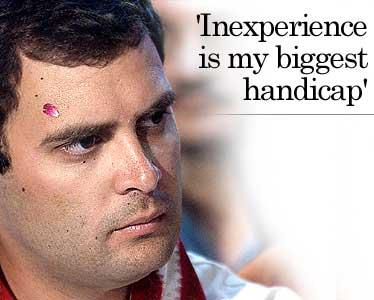
The baying of blood that has been associated with Rahul Gandhi has always been on the lines of the fact that he is a Gandhi. His Political acumen has not been tasted or seen yet. Still he has been termed as someone who owes his political ambitions to his family rather than his understanding of Indian political structure. His biggest handicap in his own words is his inexperience.

He knows that if Congress has to perform well in the long run the NSUI and Youth Congress will have to be nurtured with care and attention. His take on a democratic setup in the party should be commended. In his AICC meeting speech Rahul Gandhi called for organizational setup of NSUI and Youth Congress in such a manner in which meritocracy and accountability will prevail.

In his budget speech Rahul Gandhi called for linking implementation of governments programs to objectives spelled out under RTI. Similarly he called for more encouragement and strengthening of Panchayati Raj Institutions which according to him are empowering the poor rural to be a part of the democratic structure. Similarly no can deny the success of NREGA which is his pet project, more-so considering the fact that although NREGA is the brainchild of the UPA government but it depends on state governments for its implementation.

Neither Rahul Gandhi nor Congress can refute the fact that right now it is a party of kith and kin. Madhya Pradesh has the father son duo of Arjun singh- Rahul Singh. Then there is Kamal Nath who recently launched his son Nakul. JyotirAditya Scindia had Madhav Rao Scinda to give political lessons. Rajasthan has Sachin Pilot, son of Rajesh Pilot. Recently Subhash Yadav, the former PCC chief of Madhya Pradesh managed to secure an assembly ticket for his son Arjun. Then we have Amitesh shukla son of SC Shukla. The list is long and the names are many.

Conversely no one can refuse the fact that if Sachin pilot and JyotirAditya Scindia didn’t had their family name still they would have earned the same respect that they command now because they have time and again proved they have the understanding that is required to be politically successful. Their parliamentary voters are happy with them for the work they have done in their constituency.

When Rajiv Gandhi came into power in 1984 he candidly expressed his dis-satisfaction with the internal structure and working of the Congress party. Rajiv rose not because he had any achievements that he could boast of at that time but it was her mother’s assassination that catapulted a reluctant youth to a reluctant leader of India’s largest political party. At that time Congress was known for having more than a fair number of power brokers. According to him this was one of the three problems that plagued Congress the other two being lack of Organizational elections and intra party discipline.

In the 1984 general elections one third of the sitting MPs were denied tickets. Most of them were known to be corrupt and unscrupulous. Younger people and college goers were encouraged to become a part of Sewa dal and the state level functionaries including Chief Ministers were dissuaded from flying to Delhi to pay their monthly respect which was a norm in the times of India Gandhi.

History will tell that after pursuing these new policy for a couple of years , Rajiv Gandhi had to abandon them as they were not quite appreciated by the senior strung leaders and that was evident in the way he lost a number of assembly elections. If these valuable policies were religiously followed for a longer period then they would have benefited the party in the long run but unfortunately were aborted for political considerations.

Now Rahul Gandhi is on the same path of reforming the Congress party. He has history to guide him through but then he also has the seniors who like in the past will also try to make his path easier the way they made his father’s journey enjoyable. His Father didn’t succeed and only time will tell whether Rahul Gandhi, the scion of the Gandhi family will emerge triumph or not.

Ends


http://desicritics.org/2008/03/22/024010.php

Tuesday, March 18, 2008

Tibet's fight for freedom


It’s amazing that how easily we forget and ignore issues that are not affecting our daily life even if the concern is about oppression and annihilation of a country, its citizens and its culture.

For all these years we have chose to ignore Tibet and its demand for freedom from China. To be seen as a politically correct democracy our leaders have time and again said that they have done their bit by granting asylum to the Tibetan refugees. But does granting asylum absolves India of its responsibility that responsibility which comes when you are celebrating 60 years of democracy that responsibility which owes its existence to the freedom struggle that India itself witnessed and that responsibility which becomes due when you call yourself a south-Asian superpower ?

China has for long using its economic and political power to arm twist the international community in toeing its line that what is happening in Tibet is not a freedom struggle but a violent separatist movement. Sadly every country, including India has nodded its head in approval and they have arrived at an international consensus that Tibet is China’s internal matter and it should be left untouched to be dealt by China itself.

Feeble voice have been raised in various forums, voices that has words like ‘restraint’, ‘constraint’ but not even one of them has ‘condemned’ or ‘condoned’ the senseless killing of protestors.

In India the picture is no different. The Left which prides in calling itself the crusaders of human rights has remained shamefully mum in the parliament. These pseudo politicians, the so called intellectuals are the best example when it comes to the dirt that surrounds the Indian political system. The hypocrisy that they practice is too hard to swallow even in the Indian context. Yesterday when the Congress and the BJP MPs were raking up the issue of Tibet in parliament the Leftist were still crying over the nuclear deal.

When it comes to the third world countries there are ‘n’ numbers of laws and norms that govern their conduct. But when the greater countries are in question than the same laws are thrown out of the window. 

Earlier it was the US who shocked the world community by ignoring UNs call for not attacking Iraq and now it’s China. The world community too has done its bit by rewarding China with the opportunity to host the Olympics as to show gratitude to China for its effort in strengthening peace and restraint.

We have the Universal declaration of human rights (UDHR) and we have the International covenant on civil and political rights (ICCPR) but history has time and again proved that these for the weak and not for the powerful.

China, often called the role model for the developing country is a neighbor that one wishes was not there. Simply put when it comes to China, India lacks the political will to stand up and protest the human rights violation.

We may call ourselves and Independent country, a south Asian giant but in the midst of all this euphoria we tend to forget we are also on the fore-front when it comes the shrinking our responsibility whether its been Tibet or Iraq.


Freedom for Tibet - Standing Up To China
Published at: http://desicritics.org/2008/03/18/103355.php

Sunday, March 09, 2008

Political diary- Chhattisgarh ,Bihar and Madhya Pradesh

Chhattisgarh:

Chhattisgarh will be one of the most affected states due to delimitation of constituencies for Lok Sabha and Assembly seats. Jagdalpur in Bastar, Ambikapur, Surajpur, Premnagar and Paal would be changed into general seats from SC/ST at present. Kanker Lok Sabha seat will become a general seat from ST reserved at present and Janjgir-Korba, presently a general seat will now become a SCC reserved Lok Sabha seat. Ms Karuna Shukla, niece of Atal Bihari Vajpayee and president of All India women's wing of the BJP represents the constituency.


The heavy weights likely to be affected include former minister, Satyanarayan Sharma, whose traditional Mandir Harshoud seat will cease to exist and Ms Renuka Singh, another former minister, whose Prem Nagar seat is being converted into a general seat.


Ms Singh has challenged the recommendations of the Delimitation commission in Supreme Court and opposed the decision of the Cabinet to reduce ST reserved seats for Chhattisgarh Assembly from 34 to 29 and ST reserved seats in Lok Sabha from the state from four to three.


The former chief minister, Ajit Jogi, who represents a general seat-Mahasamund in the Lok Sabha has also pleaded like Jharkhand, Assam, Arunachal Pradesh, Manipur and Nagaland, Chhattisgarh should also be exempted from delimitation of constituencies in the coming elections. The elections for the new assembly are due in November this year.

The Chief Minister Raman Singh is hoping that his ambitious 'Rs 3 per kg rice and Rs 10 per litre Kerosene for BPL families' scheme will help the BJP government in Chhattisgarh in wooing the rural voters where 42 per cent of the population lives below the poverty line.

The state BJP leadership recently had reasons celebrate as the party grabbed victory in the recent assembly by-poll in the Naxal stronghold of Keshkal (Bastar).

The saffron party has now decided to put enhanced efforts on the impoverished regions of the state where corruption and delays stops people from getting food grains and kerosene from the Public Distribution System (PDS) as political pundits are of the view that that if the welfare schemes are sincerely implemented the BJP would be able to enjoys its success in the forthcoming assembly election.

Raman Singh has issued instructions to the government officials asking them to maintain strict surveillance to prevent any malfunctioning and corruption in the rice distribution scheme or face stern actions.

Bihar:

The delimitation of constituencies would affect adversely several leaders, including state RJD president, Abdul Bari Sidiuqqui, health minister, Chandra Mohan Rai (Ram Nagar) and sports minister, Janardan Singh Segriwal (Jalalpur), whose constituencies will cease to exist in the coming assembly elections.


Sadhu Yadav, brother-in-law of the Railway Minister, Lalu Prasad Yadav ,who was elected from Gopalganj (general) seat to the Lok Sabha will have to search new constituency as Gopalganj has now become a SC reserved seat ,Ramchandra Paswan, LJP MP and brother of Ram Vilas Paswan and Surajbhan, another MP of LJP will also have to look for new seats as their current seats , Rosera and Balia have been scrapped.


In the 243 state assembly, now, there would be 37 SC and two ST seats and six out of 40 Lok Sabha seats from Bihar would be reserved for SCs


Patna Saheb and Pataliputra will have two new Lok sabha constituencies with changes in the areas of Patna and Barh constituencies. In Patna, there will be one new assembly seat from Kumhrar, which would be carved out from the existing Patna South, Masaurhi and Phulwari constituencies.

Nitish Kumar’s JD (U) has decided to don the political cap with the party now working to make its presence felt between the OBCs and the Minorities. MJ Akbar, who once successfully contested for the MP seat from Kishanganj (Bihar) is all set for a comeback, though this time he will be going to the Upper house courtesy JD (U).

Madhya Pradesh:

If the Lok Sabha elections are held immediately in Madhya Pradesh, the Congress would be gainer .The past trends of the by-elections also indicate, the BJP would be loser, as in all the by-elections, the BJP lost the seats won by it in the last elections. The BJP lost the Khargone Lok Sabha seat to the Congress in November. In the summer, the party could not retain the seat it had won in 2004 elections in Shivpuri.


The recent 60000 crores debt relief relief given to the Kisans by the finance minister, P Chidambaram, will definitely help gain the support of the cotton growers of Khargone-Khanwda and soyabean growers of Malwa region and also in central Madhya Pradesh. Many farmers had committed suicide in these regions due to heavy loans.


The former chief minister, Ms Uma Bharti, who would be fielding her candidates against the BJP, would also help the Congress in a triangular contest.


Politically stating Congress is on a revival mode after Suresh Pachori was made the state PCC chief recently. The old PCC had virtually become defunct under Subhash Yadav and inspite of many opportunities presented by the BJP, the PCC was no abe to successfully utilize them. Now the workers are hoping for a change in fortune under Pachori as he is more taller than Yadav and commands more respect among the senior leaders like Digvijay Singh, Jyotiraditya Scinda and that would help him to silent the intra-party fighting that has been brewing for quite a while now.

The Bharatiya Janata Party's (BJP) was hoping on using the Ram Sethu issue for electoral gains in Madhya Pradesh but it got a rude shock as the Ramsetu issue backfired as was clear from its performance in the Karnataka local body elections where the Janata Dal-Secular (JD-S) emerged as the winner.

BJP and Congress both have shifted their spotlight to the sizeable number of tribal votebank in Madhya Pradesh. This was evident after LK Advani chose Jabalpur to launch his 'sankalp yatra' while Prime Minister Manmohan Singh made a visit to the remote tribal belt of Jhabua.

Tribals dominate both Jhabua and Jabalpur regions. They play a decisive role in 91 of the state's 230 assembly constituencies. Of these, 41 are reserved for the community.

Tribals would play an even more significant role if the delimitation of constituencies takes place before the polls. Under the new system, the number of tribal seats would go up.

The significant of the tribal vote was demonstrated in the 2003 assembly polls at Nimar, Malwa, Mahakaushal and Vindhya regions. The BJP swung 15 percent of the tribal votes away from the Congress and won three-fourths of the tribal seats.

Though recent trends suggest that the Tribals appear to have distanced themselves from BJP as was evident in Khargone Lok Sabha and Sanver and Lanjhi assembly by-polls which the BJP lost.

Another important part in the whole picture is to be played by Gondwana Ganatantra Party (GGP), which has substantial strength in the tribal areas of the Mahakoshal region.

Both the BJP and the Congress are wary of GGP and if the Gonds in the Mahakoshal region, where 60 percent of the voters are tribals, decide to go with GGP, the electoral prospects of the two mainstream parties will surely suffer.

Similarly Mayawati’s BSP which recently organized a show of strength in Bhopal, will also give sleepless night to both BJP and Congress strategist as BSPs policy of wooing the Brahmin vote bank is sure to change the political equations in the state.

Saturday, March 01, 2008

Indian media-Leader oriented, Reader neglected

'Freedom of media' is a relative term. It is just not limited to the freedom enjoyed by the media to report everything without being stopped forcefully but also obliging the members of media fraternity so as to stop them from giving out a true picture. The term "obligation'' assumes enormous proportions in the backdrop of media ethics. The modern media is like the now banned ‘Mumbai's Bar Clubs’ with Market guiding them in all respect. Editors have become Bar Girls? .

All major Indian newspapers with few exceptions have now turned into what is popularly known as "Response run" rather than "editorially run" papers. There was a time when management people were given independent responsibilities to generate revenue and the editorial wing was consider sacrosanct. Now the most of the editors of these papers have to cut a sorry figure in face of a Harvard, IIM or any management institute educated manager, and wisely they have now learnt to buckle under the demands and whims of the Response. These days an MBA has more say than an editor in deciding the contents or colour of a newspaper.

As a result of this approach content and quality wise these newspapers are heading southwards and there is nothing astonishing in it as when Ad and revenue generation becomes important the priority than the quality of newspaper goes down. This is a cardinal principle which is always true. The newspapers and magazines have now become any consumer product with perishable value.They have lost their retention capacity by the readers.

The Correspondents are now given the additional responsibility of procuring state sponsored advertisements for their respective newspapers. There are examples of the state and district level or even block level stringers being asked to collect advertisements for special supplements to be brought on Republic Day, Independence Day, State Foundation Day and even foundation Day of the newspaper itself. This is happening even in the villages of Bihar, UP and Jharkhand, where Hindi readership is very large.

This is true for almost all the publications, and in this context it would be foolish to expect that a newspaper will encourage the correspondent to report against the same government which is providing the publication with advertisements that runs into crores.

The 'old lot of journalists' who started their career in the 60s or 70 now find it increasingly difficult to function in this comparatively new Response oriented market environment which demands from them a lot more than just good writing skills.

Everyone knows that Vinod Dua, Rajdeep Sardesai and Barkha Dutt recently accepted the state sponsored Padma Shri but not many are aware of the fact that Pranoy Roy declined the same when it was awarded to him just after the UPA came into power.

There was a time when even the fear of state sponsored prosecution was not able to stop media from speaking out against Indira Gandhi and emergency. Sadly the times have changed.

Readers who have been committed readers of the the self proclaimed Leader of newspapers ,particularly those preparing for the Civil Services now do not subscribe the paper as they are getting better contents in other newspapers .They are getting thought and views from non-leader newspapers as the Leader has lost its serious reader value contents. The Leader is growing in the Market, but not among the Minds as its has lost its "Retention Value". The Leader is more concerned about its TRP now giving good bye to quality reading materials and news. The Response oriented editorials are not liked by the serious and committed readers.

Readers loyalty has shifted from the Leader as the paper has now turned into a 'skin-friendly' paper of the establishment of the Day. The Leader's editorial page which perhaps was its best part too has deteriorated and as for the Sunday pull-out page the less said the better. It is neither interesting nor entertaining leave alone educative.

This nexus between media-politicians, media-industrialists has always been there but earlier it was healthy interface and the media always knew that being the fourth estate it is under the obligation to keep a check on the other institutions of democracy. And I don't deny that the checks and the controls are still there but now it is more of a "manipulated checks''.

The Freedom of Press is meant only for the Leader and its subsequent followers and not for Readers is now confirmed.

http://desicritics.org/2008/03/06/023744.php


LinkWithin

Related Posts Plugin for WordPress, Blogger...