Wednesday, September 03, 2008

Madhya Pradesh- August

When Uma Bharti quit BJP 30 months back and announced the formation of her own party (Bhartiya Janshakti), political pundits predicted that she would give BJP a run for their money in the Central state of Madhya Pradesh. After all it was she who was wholly responsible for BJPs sweeping win over Congress in the previous state elections where Digvijay singh led Congress was completely routed.

But now seasons have changed and so have the predictions. After successfully defeating Congress, Uma Bharti conveniently forgot that it was the BJP wave that had played an important role in her fight. Not only MP, but Chhattisgarh and Rajasthan were also won convincingly.

She was made to think by her inner coterie that it was she who had led the BJP into power and without her BJP will find hard to survive. Nearly 2 and half years later, it’s her party that is finding hard to breathe. The maverick leader is learning the never ending political lessons the hard way.

Her party is on the brink of collapse just three-months before the Assembly election in the State. And the proverbial rats are jumping off the sinking ship. Recently her one of the most trusted confidant and party general secretary Bhagwandas Sabnani came back to the Bharatiya Janata Party fold.

Sabnani’s revolt came as a bolt of blue for Uma who had still not recovered from the twin shock of desertion of the then party national president Raghunandan Sharma who deserted her after he was promised a Rajya Sabha member from Madhya Pradesh with support of BJP. Before that party's national general secretary and former Union Minister Prahlad Patel too snapped his ties with Bhartiya Janshakti on issues of contesting the Gujarat state elections. And before that, it was Madan Lal Khurana, a former Bhartiya Janta Party Chief Minister who went back to BJP.

Those of few who are still in BJS are counting the days when the inevitable will happen and Uma too will crossover to BJP. Sources feel that the wait will be over by the time the dates for the state elections are announced.

Without Patel the party is under financial crisis and is heading for a major split. The Bhartiya Janashakti has witnessed mass scale desertions recently and paucity of funds and resources have ensured that the party workers will have to put no extra efforts to break the 30 months old ties when time calls.

Shivraj Singh Chauhan continues to enjoy the good luck that has been working for him from the day he took over as the CM. Chauhan who was the third CM after Uma Bharti and Babu Lal Gaur recently celebrated 1000 days in office.

Experts feel that with no major controversy, except the “Dumper deal” to court him, Chauhan has performed well in the run-up to the elections. The BSP ( Bijli – Sadak-Pani) which was the main issue in the previous election has been negated by the work carried out by his government. This has resulted in the opposition Congress futilely searching for an issue.

The various people friendly scheme that has been launched in the state like the Kanyadaan Yojana for marriage of poor girls, Ladli Laxmi Scheme for girl children and Annapurana Yojana for subsidized food grain, which has been quite a hit in the neighbouring Chhattisgarh too has ensued that Shivarj will have issues to share with the electorates once the electioneering begins.

Though some section feel that corruption has eaten away the political benefit that could have been gained as the ground level implementation has not been quite up to mark for the schemes to make their total impact. But with the CM putting his foot down before the code of conduct sets-in the desired result will soon trickle in.

Also the party on its part has asked its entire ministers to pay attention to the district that have been put under their charge and spend at least five days in week in these areas.

A high profile meeting of the top leaders of State Congress in Chinndwara on August 22 grabbed quite a few eyeballs in the state. Almost all of the senior leaders of the party including Kamalnath, Digvijay singh, Jamuna Devi, Jyotiaditya Scindia, Ajay Singh, V Narayan Swamy and Suresh Pachori were present at the meeting.

During the meeting Digvijay singh and Subhash Yadav caused a flutter among many feathers when they announced that they were in support of Kamal Nath being projected as the CM.

Later it was reported that the AICC has taken serious note of floating Nath’s candidature as future CM and summoned both Yadav and Singh. Union Minister of State Jyotiraditya Scindia too had strongly objected over the announcement. It is no secret that Scindia, Kamal Nath, state Congress President Suresh Pachauri and Ajay Singh, son of Union HRD minister Arjun Singh all are CM aspirants and they have started their efforts to see to it they get the coveted chair if the Congress wins power.

Monday, September 01, 2008

The mystic gaze

Memories are gateway to the moments that are not lived again


Times are rare when one experiences the proverbial “time freezes” moments; when everything stops as if a magic spell has been cast.


I have been through this magical moment twice in my life. In both the circumstances the cause for the phenomenon (a girl) was identical and the place of occurrence was also the same. I first experienced this when I was in class 10th and then again in class 12th.


It was lunch time and after having filled my stomach I went to the water cooler to wet my beak. As I reached the coolers which were kept at end of the famous “corridors of Jawahar”, I heard a shriek and as I turned back I saw two small boys, probably 2nd grader, writhing in pain.


Presumably both of them were running towards each other through opposite direction and had collided into each other. One of the boys was lying on the ground, his head bleeding while the other was struggling to stand on his feet. The fallen boy was holding his head and the shaky one was covering his mouth. Apparently the teeth and the head had taken the maximum brunt of the collision and now both were in pain.


As the boy with the painful teeth swayed and fell he was held by a girl. And that’s when our eyes met.


The time stopped, everything came to a stand still and nothing moved. Our eyes refused to blink. It was as if everything except the two of use had ceased to exist…..the spell had been cast. It was those ‘once in a lifetime experience’.


It's difficult to say that how long the spell lasted, because remember the ‘time had stopped’. But when finally it was broken, I found myself staring at her and I could experience the numerous sounds and the various melee that filled the corridors of Jawahar.


The second of the incident happened nearly two years after the first and it occurred at the classroom gates of my class, 12C.


After the first lecture ended, I went out for a stroll and when I came back, I found the classroom doors closed. The English subject teacher who was Anita Chaturvedi mame (popularly known as AC madam) had already started taking the attendance.


Not wanting to miss the class, I opened the door and stepped in. But my steps stopped in mid-air as the moment I pushed the door it was pulled from the other side.


Standing in front of me was she and we were just an arms length apart. Our eyes met and the time froze again. A hush fell over the school, the murmuring stopped and so did the teaching. As some great writers have often described it was like as if “I was floating in space; lifeless and weightless”.


More than 8 years later I still yearn that spell to be cast again…and to be spell bounded by her eyes again.

Thursday, August 21, 2008

Diminishing returns of Congress

The political assessment about Congress’s future in the Hindi belt of Madhya Pradesh and Bihar appears bleak and weak .


In Madhya Pradesh, the state Congress in being headed by Suresh Pachouri, a leader who has never won an election, not even that of municipality. On top of that, Suhash Yadav, Jamuna Devi, Digvijay singh, Kamal Nath, Arjun singh and Jyotiraditya Scindia, all have their own nut to grind leaving Pachori with the difficult task of pleasing everyone and dislodging the firmly rooted BJP from the state. In short Pachouri has to manoeuver through a maze that has no end.


The tremors of intra-party factionalism has never allowed Pachouri to prepare for himself a firm ground, standing on which he can at least think of challenging Shivraj Singh Chauhan.


At the moment, most of the strings that are controlled by the Digvijays, the Kamalnaths and the Scindias are being pulled from Delhi, but once the monsoon of election sets in, all these clouds will make a beeline for Madhya Pradesh and then Pachouri will have his task cut out.


Relationship between Pachouri and KamalNath are not in the best of state and only time will tell how much damage will the Chindwara power house do to Pachori. Ajay Singh, son of Arjun Singh and Nakul Nath,son of Kamal Nath will add their own bit to the whole story as both of them will try to establish themselves in the political map of the state and the assembly elections will be the arena that will decide their rise or fall.


While commenting on the situation of Congress in Bihar one will strain his yes and yet find no leaders to talk or write of. The word ‘bleak’ will be an understatement to describe the situation, as the state congress is virtually defunct in this eastern state.


The fact that AICC secretary in charge KC Deo, who was the State Congress in-charge for one year, never thought of visiting Bihar even once speaks volumes about the importance the Congress leadership attaches to Bihar.


There are only three Congress MPs from Bihar in the parliament. Nikhil Kumar (former Delhi police commissioner and son of former chief minister,Satyendra Narayan Sinha), Meira Kumar (daughter of Babu Jagjivan Ram) and Shakeel Ahmed(son of former Bihar speaker,Shakoor Ahmad). The party also has merely nine MLAs in the state assembly, and no one will surprised if it’s representation in the state goes down even further in the future.


Recently, Bihar Pradesh Congress saw a new chief being appointed. Anil Sharma who has emerged through the corridors of student politics of Patna University recently replaced Sadanand Singh.


Sharma, like Pachouri has never won an election not was even an MLC, fits more comfortably in the role of a palmist. He is an expert palmist and astrologer and if one is to go by news coming from within the party, Sharma got the job after he was recommended by Vincent George, the ‘now-almost-forgotten’ secretary of Ms.Sonia Gandhi. George reportedly pushed Sharma’s candidature because he was pleased by the accuracy of the forecasts predicated by him while reading George’s palm.


Unlike in other states, in Bihar it is Lalu Yadav who decides the ticket distribution for the Congress party. The state Congress has paid a very heavy price to keep the alliance between the RJD and the UPA at the Centre functioning. Lalu while working in a systematic way has made sure that Congress is brought down to a point, from where it will take years if not decades to stand up again. And the one party that has gained from this has been Ram Vilas Pawan’s LJP. For years to come the electorate battle in the state will be fought between the troika of JD (U), the RJD and the LJP. Leaving both the main national parties, the BJP and the Congress to play the role of a mere substitute


In Madhya Pradesh and Chhattisgarh, the Congress is going to contest the elections on its own strength. In the past, it had made “strategic arrangements” with the Bahujan Samaj party and the Left giving them a couple of constituencies, but in Bihar, it is dependent on the RJD only. If it goes alone in Bihar, the party can become organizationally stronger. The party leaders had recently told the treasurer, Motilal Vora that the workers at the grass root level were “jobless” even during the election campaign as they were not required for campaign as most of the seats were given to the RJD in alliance. They feared the party may lose its ground in the villages, if this trend continued for long .The party may no win more seats, but it may be revived with the “involvement” of the workers in the villages.


In Chhattisgarh the prospects appear better for the Congress, as the tribal belt of Surguja and Bastar are not happy with their respective BJP MLAs. In the previous election, it was this belt which voted against the Congress and led BJP to power. The Salva Judum movement too will come into play as most of the tribals are disenchanted by it. This tribal belt will perhaps decide that who amongst the seekers will finally get the treasure.


The tickets for the forthcoming assembly elections is Chhattisgarh will be distributed through mainly two counters; one being manned by the former CM and MP Ajit jogi and the other that has the octogenarian Motilal Vohra at its helm. In the political equation that will possibly emerge in this state, many other leaders like Satyanarayan Sharma, Charan das Mahant, VC Shukla will also play small yet pivotal part to make the equation more ‘exciting’.


The intra-party factionalism and the honest image of Raman Singh will be the only thing that may stop Congress from capturing the required number of seats. While on one hand the Rs 3 kg rice scheme for the poor in Chhattisgarh may help Raman Singh to retain the tribals votes but on the other the below satisfactory performance of his colleagues among the tribals will make it difficult for Raman to consolidate on the advantage that he will get from the rice scheme.


Dilip Singh Judeo, who was a chief ministerial candidate in 2003 has been sidelined and is now busy with his re-conversion programmes.


The factionalism that has emerged in this state has led to the birth of two poles for the Congress workers to choose from. ‘With Jogi’ and ‘Against Jogi’, is the possible resting house that will probably come-up in the state. In fact the detractors of Jogi within Congress may well outnumber his enemies that are in the BJP. The birth of ‘Against Jogi’ group can be traced to 2000 when the state came into existence and Jogi was appointed the first CM. Claims of many other leaders like the Shukla brothers and that of numerous other aspirants were dismissed by Sonia Gandhi while appointing the much ‘junior’, Ajit Jogi. Seven years later the swords are still drawn and though each side claims the odd success in the battle, but the one final war is still to be fought.


Ends

Wednesday, August 06, 2008

Bihar Analysis- July

Bihar, where caste equations are always of paramount interest, saw a new director general of police in the form of Devki Nandan Gautam,a 1974 batch IPS from a dalit community. Gautam was made DG of police in place of a Brahmin, Shiv Chandra Jha.


Claims of two other senior IPS officers were ignored while superseding Gautam. Gautam, is considered an upright honest officer. The then chief minister, Karpoori Thakur during a debate in the state assembly had described Gautam as God for the poor.


Gautam was being shunted for the last 17 years. First during the Lalu-Rabri regime and then when the government changed he was ignored for the initial two years by the Nitish Kumar government due to the pressure of senior Janta Dal(U) MP, Prabhunath Singh, against whom Gautam, was monitoring a murder case.

Nitish Kumar has obviously tried to send a message among the masses about his intention to give an honest police administration in the state by making Gautam, the new DG of police. The police headquarters so far has been a hot bed of groupism.


For the second year in succession, Patna remained waterlogged during the monsoon session. Boats were pressed into service the posh locality of Rajendra Nagar, after the entire area was deluged. The residence of the deputy chief minister, Sushil Kumar Modi, senior politicians, bureaucrats and doctors was marooned and Modi had to shift to safer place alongwith his family for about a month. Medical facilities also came to a standstill as the clinics and hospitals were under knee deep water.


The district administration ordered closure of all schools as the school buildings and class rooms were waterlogged and movement of buses and autos became impossible due to flood on the roads.


The chief minister blamed the Rain God for the water logging and the urban development minister, Bhola Singh, held the previous RJD government responsible for the watery mess, alleging that the government did not create drainage system.


The entire monsoon session of the State legislature was dedicated to waterlogging problem and the entire opposition boycotted the two houses for the entire session. The leader of the opposition, Ms Rabri Debi, remained absent for the entire session inviting criticism from the treasury benches.


The Patna High Court intervened again as the state government failed in restoring normalcy in all the universities, where the teaches and the non-teaching staff are on strike for the last two months. Neither the scheduled examinations are being held nor are fresh admissions taking place. The new academic session has not started as yet. Since, the staff did not get salary for the past two months many employees died of starvation. The High Court has also admitted a public interest litigation filed by a student and issued instructions to the government asking it to take immediate steps for withdrawal of strike.


CM Nitish Kumar’s criticism of the Railway Minister, Lalu Prasad Yadav and describing him as the “world biggest liar” kept the politicians and media engaged for a week. The Railway Minister also retaliated and called Nitish depressed and a frustrated politician. Kumar said “Lalu Yadav’s only achievement as Railway Minister was to link his village and Rabri Devi’s village with railway line’’. Kumar was also upset over shifting of railway wheels factory project from his assembly constitutency, Harnaut in Nalanda to Chapra, Lalu Yadav’s constituency.

Madhya Pradesh Analysis - July


As with the other state bodies of the country, buoyed with the UPA wining confidence motion in Lok Sabha, Madhya Pradesh Congress is also making efforts to boost up the party workers but its work is being hampered due to the lack of unity, as disputes between leaders refuses to disappear.


BJP gained power in the previous state elections by raking up the pitiable conditions of BSP (Bijli-Sadak Pani) in the state. According to commentators the situation in the state hasn’t improved much and continues to remain the same but the main opposition in state assembly, Congress has not been able to ‘market’ this among the mass.Anti-incumbency won’t be much a factor in the forthcoming state elections scheduled for November, hence the Congress will need to work out some other formula if it wants to dislodge BJP.


Corruption which has recently beset the state BJP was an issue that could have been developed and used as a tool by the opposition but that too was not properly utilized. According to Party functionaries even though the state has big stature leaders, yet most of them are more active in the Center and hence the state organization is not able to utilize their experience and tact. Here too the party is facing a catch-22 situation as a section of the workers are wishing for bringing the Kamal Naths and the Digvijay Singhs into the state for a prolonged inning but another section of the party fear that too many cooks will spoil the broth and will result in more intra-party disputes.


As widely reported in the local media the intraparty dispute was clearly visible in two meetings that were held in two different places. One at the state PPC office in Bhopal, Indira Gandhi Bhawan and the other at the residence of a Union Minister Kamal Nath in Delhi.


Though it was said that the meeting at Kamal Nath’s place was to deliberate the future strategy for the state but those present in the meetings say that the subject of the meeting was an individual rather than the organization.

Among others who were excluded from the meet at Delhi included AICC General Secretary Digvijay Singh, Union Minister Arjun Singh and senior leader Satyavrat Chaturvedi.


Two days later, Bhopal became the hotspot as supporters of Digvijay and Arjun Singh met to work out the future strategy. The most notable of the absentee was Madhya Pradesh Congress Committee (MPCC) chief Suresh Pachauri.


As such instances of factionalism continue to come out, the view that Congress will lose hands down will grow strong.


The long standing demand of the state Congress leaders for arranging a visit of Gandhi scion to the central state was finally fulfilled as the Congress general secretary attended a special function in Bhopal and interacted with children in a school owned and promoted by a well known media group.


Rahul Gandhi also took stock of the political situation in the state through a brainstorming exercise which involved State Congress president, Suresh Pachouri and chairman of the State Congress Campaign Committee Ajay Singh.


Detractors of the state PCC chief Suresh Pachori, were left disappointed as the former union minister was praised by Rahul Gandhi for his efforts to bring the state organization into shape.


The state assembly witnessed unruly scenes as the opposition’s demand of setting up a judicial enquiry into the communal violence that was witnessed in Indore went unheeded.Setting a record of sorts no question hour could be transacted during the entire monsoon session, while more than a dozen official bills, including the supplementary budget, were passed without debate.


The state also witnessed two bandhs in the month of July; one in Indore and the other in Chindwara. Bandh was imposed in Indore after a communal clash between the supporters of the bandh led by the Hindutva group like RSS and VHP clashed with a section of the minority group. The bandh was called by these organizations to protest the decision of the Jammu and Kashmir government to revoke the decision to transfer land to Amarnath Shrine trust board.


Chindwara which is the parliamentary constituency of union commerce minister Kamal Nath, witnessed a bandh that was called by the Gondwana Gantranta party (GGP) to protest against protesting against the death of a boy at a gurukul (school) run by the asram of spiritual guru Asaram Bapu. This is the second death that has been reported in the asram in two days.

Saturday, August 02, 2008

Summer of 2001@ Jawahar

i got my first real six friends
met them in the corridors of jawahar
we played till we all got tanned
it was not the summer of 69'

me and some guys from school had a crush
and we tried real hard
Laad quit and VJ got beaten
they shud have known it will never get far

o when i look back now
that summer seems to last forever
and if I had a choice
I would always wanna be there
those were the best days of my life

ain't no use in complainin
when u got a job to do
got thrashed near Kasturba
and still we stood tall

dancing with u in Ranjeet's porch
my heart flew helter-skelter
and when it was time to say farewell
i knew it was now or never
those were the best days of my life
back in the summer of '01

now we are out of Bhopal and graduated
it's better to take you out of my mind
i guess nothing can last forever...forever

and now the times are changing
looking back at everything that's come and gone
sometimes i meet my friends and figure bout what went wrong
dancing with u in Ranjeet's porch
i shud have told i would be there forever
and when u held my hand i shud have known it was now or never
those were the best days of my life

oh yeah...

back in the summer of 01
that was the summer of 01...

In sweet and in sour memories -- 1996-2001 :)

Sunday, July 27, 2008

India losing to terror

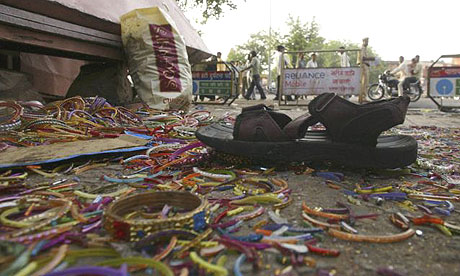
The country again wakes to a morning that is laden with the news of the increase in number of dead and injured in another bomb blast that took place in the country somewhere. This time it was Ahmedabad and one day before it was Bangalore. Who knows by the time I conclude this write-up another blast would have ‘rocked’ the nation.

Since October 2005 when a bomb went off in the crowded Sarojni market of Delhi, just a day before Diwali in which more that 60 people died, 11 more such incidents have rattled India. The most deadly being the July 2006 serial blast in Mumbai’s trains in which over 200 people were killed. And not surprisingly we cannot say that we have been able to solve the case or even figure out the identity of the perpetrators. In most cases the obvious answer that one gets from the investigative agencies is the SIMI (Students Islamic Movement of India), the HuJI-B (Harkat-ul-Jihad-al Islami Bangladesh) or the HuM (Harkat-ul Mujahideen).

The country witnessed its first major strike in 1992 when the financial capital of India was rocked. It was aid that the fundamentalist behind the Mumbai attacks were avenging the demolition of Babri structure and the subsequent riots. Then also the think-tank of this country has talked of formulating counter-terrorism policies that would make future such strikes much harder.

In very simple terms Terrorism is violence, or the threat of violence, calculated to create an atmosphere of fear and alarm. Terrorist acts are intended to produce effects beyond the immediate, having long-term psychological repercussions on a particular victim audience. The fear created by terrorists may be intended to cause people to exaggerate the strengths of the terrorist and the importance of the cause, to provoke governmental overreaction, to discourage dissent, or simply to intimidate and thereby enforce compliance with their demands.

Terrorist actions are generally carried out in a way that will achieve maximum publicity. Unlike other criminal acts, terrorists often claim responsibility for their acts.

None of the two major political parties, the Congress or the BJP can escape blame when it comes to who stands tall on the criteria of which of the two countered terrorism efficiently.

In the early 2000 when the BJP led NDA was at the power the country saw two major terrorist strikes that will be forever embedded in our memory. The Hijacking of the aircraft IC 814 and the attack on the Indian parliament which till then was considered impregnable and unthinkable.

The Indian Airlines flight, IC -814, carrying 178 passengers was hijacked on 24th December 1999 after it took off from Katmandu. The aircraft landed at three different places (Amritsar, Lahore and Dubai) before it flew to Kandhar. No counter-hijacking action was taken while the aircraft was still in the Indian airspace. In fact the pilot of the craft deliberately delayed the departure of IC814 from the Amritsar airport and waited for more than half hour to give the Indian establishments chance to mount a takeover. His wait was in vain. Later the then national security advisor, Brajesh Mishra stated that while the plane was still in Amritsar he had given instructions to the security agencies to shoot at the tyres of the craft so as to make it immovable. He also very candidly admitted that his instructions were not heeded to; why? Even he doesn’t know.

Brajesh Mishra at that time was no ordinary man or a bureaucrat. He was the national security advisor and the closest confidant of the Prime minister, even LK Advani who at that time was the Home minister couldn’t boast of sharing the same intimacy with Vajpayee when it came to Mishra. And if he says that his instructions went ignored then we can well imagine the whole anti-terrorism machinery the country had at that time.

It can be termed as nothing but a diplomatic failure that Vajpayee led government was not able to take either Pakistan’s or Saudi Arabia assent for a commando-led operation to take control of the craft when it was still in their respective airspace. Surely a commando operation was more feasible in Pakistan or Dubai rather then Afghanistan as it was subsequently discovered.

The subsequent chain of incidents are well- known as the Indian government had to resort to a face-saving exercise and release 3 dreaded terrorist in return for the safe release of the passengers aboard the ill-fated aircraft.

The then foreign minister personally took the terrorist to Kandhar. The three were Maulana Masood Azhar, Mushtaq Ahmed Zargar and Ahmed Omar Saeed Sheikh.

After his release Maulana Azhar set up Jaish-e-Mohammad in early 2000 which is accused of the deadly attacks on Indian targets, including one on the parliament in Delhi in December 2001.Mushtaq Ahmed Zargar after his release renewed the activity of Al-Umar Mujahideen in Muzaffarabad, close to the LOC, in recruiting and training of young Muslims to the independence war in Indian occupied Kashmir.Zargar while in custody revealed his enormous hatred for Non-Muslims especially Jews, Hindus and Christians and once famously said "If you want to end these terror strikes in the world then either accept Islam or wipe out Islam" .

The last of the freed terrorist who was once a LSE attendee, Sheikh Omar Saeed was later arrested by Pakistani police on February 12, 2002, in Lahore for his involvement in the Pearl kidnapping and sentenced to death.

The whole IC 814 incident the way in which it was handled is a terrible blotch on the BJP and India as a whole and is often used as an example of “how not to deal with hijack situations”.

Though the terrorist strike on the parliament was thwarted by the individual bravery of the sentinels yet it pointed out the glaring deficiencies in the over-all security setup of the seat of democracy and the weakness and failure of the intelligence gathering mechanism of the country. It was not the first time that the intelligence agency had failed us. Kargil was happening right below our nose and we were in deep slumber.

Since then the terrorist strike have increased at an alarming level and on an average a major terror strike is being carried out at a period of every 3-4 months.

Although the security agencies have been successful in busting quite a few modules, the most recent being the SIMI module which was taken out in Indore which led to the arrest of scores of SIMI operatives including the arrest of SIMI chief Safdar Nagori and the discovery of many nefarious designs, yet terror has no sigh of abetting.

Terrorist too are evolving and now have took a liking for soft targets and are shying away more and more from hard targets like military bases. Soft Targets are relatively unguarded or difficult to protect from terrorists, and therefore yield a higher probability for a successful attack. The recent blast in the markets of Bangalore, Ahmedabad, Jaipur and Delhi confirm this shift of pattern.

Similarly they have also adopted the serial bombing method which are more ‘productive in terms of the number of deaths and have a more deep impact psychologically. Also since the serial bombing doesn’t require huge amount of explosive device at a single place, they stand a much better chance of being undiscovered hence causing maximum damage.

After every such strike the political establishment wakes up and the President, the Prime Minister and the various political parties issue statements of condemnation. The Home Minister issues stern warnings that terrorism would not be tolerated and that the terrorists involved in the latest attacks would be brought to book. Ministers then visit the hospitals in the city where the terrorist attack has taken place to show their sympathy. And then it gets over.

Nothing concrete is done, some knee-jerk reactions at the state level; transfer of officials is the standard statutory method to mollify the public sentiments.

The country earlier had the stringent POTA laws. The POTA might not have been successful in deterring the hardcore terrorists but it had the desired effect on those minds that were still at the stage where they could be brought back in to the social mainstream. It deterred the gullible minds from taking the path that was both detrimental to them as well as the country.

But the law was revoked after the Congress came to power. In fact Congress in its election manifesto had said that it would revoke POTA if it came to power. It said that POTA was a draconian law and was aimed against the minorities. Agreed that there might have been cases of police excesses under the law but it should not have been done away without an alternative legal tool.

The minority appeasement policy that is followed by political parties in general and Congress party in particular has not helped either. A Former police commissioner of Mumbai said that the state minorities commission, civil rights activists and mohalla committee workers had cautioned the police against conducting combing operations, random checks and make preventive arrests. Time and again intelligence agencies have expressed helplessness in wake of political interference that has hampered the agencies from effectively investigating the incidents

The failure of the implementation of the finding of The Justice Srikrishna Commission report acts like a fuel to fire. It indicted 31 police personnel (from officers to constables) for abetting the rioters. But no action has been taken against the bigger leaders that have been named in the report.

The politicians play their game of linking the minorities to the terror strike. They stand on dais and scream of ‘stopping the state from alienating the minorities’, thereby giving the perpetrators an identity based on religion.

States like Maharashtra has its own set of stringent anti-terror law. The MCOCA (Maharashtra Control of Organized Crime Act.) which has been termed draconian by some rights activist but they conveniently forget that it’s this draconian law that has curbed the terror incidents in the state. Similar anti-terror laws passed by the Gujarat and Maharashtra are lying with the president office for the past 4 years for its necessary assent and it speaks volumes about the Center’s attitude on its mindset to tackle terrorism.

Terror strikes can never be rid of completely, but they can be minimized to a negligible level. Sets of effective steps are the need of the hour. A closer and increased co-ordination between the Center and the State on measures to curd terrorism is needed. Recently the Central government had issued a high alert warning to all the states asking them to step up vigil, but it seems that either they were not taken seriously or were completely ignored. Also it would be more effective if the special Anti Terrorist squads (ATS) that are present in most of the states work in tandem.

In the long-run political establishment should think of forming a special agency that would specifically deal with terrorism, something in the lines of the IB or the Vigilance agency, both who have a specific nature of job. The agency should be headed by a senior rank IPS officer and should be directly under the PMO so as to reduce political hindrance and interference. This will help in fixing responsibility and channeling of concentrated resources and efforts in the right direction so as to curb terrorism.

Political will to weed out terrorism is the foremost of all. If that is not present then even the best of counter –terrorism measures will be rendered ineffective. Stress should be led on intelligence based policing. Due importance has not been given to the intelligence branch and is most states it is used by the political parties to gauge to mood of the voters and the strengths and the weakness of their rivals.

In the morning of the 22nd of July when the confidence motion was to take place, the CBI chief gave a courtesy call to the prime minister residence. It is anybody’s guess that what the nature of the courtesy call was.

If such terror strikes are not curbed then the demand for a state supported attack into foreign territories and into Pakistan occupied Kashmir (PoK) to destroy the terrorist camps which till now are sporadic in nature will gain more recognition and appreciation and then the situation may get more trickier for the government

A lot of money is required to support intelligence gathering which unfortunately is not happening in this country. Similarly Sensitization of people and greater awareness on sustained basis in the battle against terrorism will pay a great dividend as the terrorist work while staying between us. Also religion and fanaticism should be looked through two very different perspective, they should not be mixed for anyone’s convenience.

Finally our resolve to spring back to life after every such attack is the most effective method that can be taken by an ordinary citizen to combat the evil designs of these terrorists.


Ends


http://desicritics.org/2008/07/27/132626.php


Wednesday, July 09, 2008

Chhattisgarh political - June

Analysis

Ahead of state polls in Chhattisgarh, development issue seems to be emerging as a buzz. While Chief Minister Dr Raman Singh is riding to retain power on the same issue, three elected panchayat representatives have to go for failing to do “development”.


Chhattisgarh chief minister Dr Raman Singh took a ride state-wide to spell how his government defined and designed development of the state. The 19-day and six-phased Vikas Yatra (development road-show) concluded on June 29 with a big respite for the ruling party that the yatra went on right road.


“The Vikas Yatra was a great success and people responded to it endorsing the development works taken up by the BJP government (since it came to power in December 2003),” Dr Singh said after the campaign that ended in Jashpur on June 29. BJP President Rajnath Singh and state in-charge for party affairs Ravi Shankar Prasad were specially present at the concluding function.


The BJP leadership however have all the reasons to smile. For, the Vikas Yatra that only centred in and around the development issues evoked good response from the people at different corners of the state. The chief minister wholeheartedly sanctioned new development works that would cost crores of rupees.


The campaign started from Maoist-infested Dantewada district on May 23 and ended in Jashpur—the centre of inter state gangs active in Chhattisgarh and Jharkhand. But law and order was not an issue that was evident the way people clapped for Dr Singh when he addressed gatherings from the stages and roof-top of his chariot (rath).


According to political observers, the BJP leadership is well aware which cards to play in the ensuing assembly elections, due for October-November. Since the issue of development is the biggest card to deal with the anti-incumbency, the saffron strategists know very well that it will hit the right target to counter the opposition party, Congress, which is yet to work out a plan to propel its cadre to election mode.


The faction-ridden main opposition party Congress is struggling to set its home in order before attacking the ruling party. The simmering differences between different camps in the party spilled out in open on June 27 when party activists clashed for an ugly show in Korba in front of senior party leaders who have been entrusted to take the challenges of BJP and ensure victory of the Congress that was rooted out of power in December 2003.


The Congress leaders are confused to tackle the anti-incumbency factors while the BJP has scored over to spell out its development agenda and have gone before the people through the Vikas Yatra well ahead of the onset of election campaign to inform the electorate about its achievements and archives. For the Congress leaders, it would not be an easy task to grill the government on the issue of development.


Had the Congress succeeded in launching a campaign before the BJP’s Yatra, things would have changed as people could not have been convinced with the development formula of Raman Singh. During the regime of previous Congress government headed by Ajit Jogi, the state had no doubt seen a new horizon of development. but the failure of Congress party to encash the issue resulted in its ouster from the power.


The BJP leadership would not commit the same mistake. And the Vikas Yatra strategy stands testimony to it. The party is also planning to take Vijay Yatra (victory campaign) before the electioneering starts on the same issue to consolidate its position before the electorate. The saffron brigade knows the importance of development. And it was in its tenure that Chhattisgarh created history by voting out three panchayat presidents for failing to take up development work.


People of Gunderdehi, Rajpur and Nawagarh Nagar Panchayats on June 17 created history by toppling the President of their respective civic body by casting vote against them by exercising the right bestowed under the state Nagar Palika Act to recall elected representatives.


Under Section 47 (recall of the president) of Chhattisgarh Nagar Palika Adhiniyam 1961, election can be sought to recall the elected representatives if three-fourth of the total number of corporators in the municipal bodies give in writing to the collector that the president has lost the confidence of the body and hence election be held to recall.


Though people’s power ousted the three elected representatives, progress (development) and politics were the main driving force that led to the historic battle of ballots in the three sleepy towns of Durg and Sarguja districts. The corporators blamed the presidents for obstructing the development works and affecting the progress of the panchayat area while moving proposals to collectors.

Bihar Political- June

Analysis


The rebellion in the BJP against the deputy chief minister, Sushil Kumar Modi, seems to be over in Bihar with the central leadership declaring him as the leader of legislature party following his majority in the organization.The party summoned all the legislators to New Delhi and held secret voting. Modi got popular support in the secret ballots and the party president, Rajnath Singh declared him as the undisputed leader. For the last six months, the deputy chief minister was facing rebellion in the legislature party following cabinet reshuffle in which some influential party ministers were dropped from the cabinet.

The rebel leaders who had been camping in New Delhi returned to Patna after losing the vote of no-confidence and reaffirmed their faith in Modi. The two senior ministers, Ashwini Kumar Chaubey and Nandkishore Yadav, who were leading the anti-Modi campaign also declared their faith in Modi .With Modi returning to Patna after getting support of the central high-command and also his legislators, the BJP is now engaged in preparations for the coming Lok Sabha elections. The central high-command can not dare top ignore Modi,a senior party leader and also a popular leader of the backward castes ,who are deciding factor in the elections in the state. Modi has also backing of the Sangh, since he was former Pracharak too.


New political equations are seem to be developing in the state/The Lok Janshakti party chief, Ram Vilas Paswan, has appreciated the role of the chief minister, Nitish Kumar, in developing the state and declared Kumar was doing better than Lalu Prasad Yadav.Paswan, who is keen to get his wife elected as member of Parliament ,is also trying to have adjustment with Kumar For both Kumar and Paswan, Lalu Prasad Yadav's RJD is the common enemy and Paswan who had contested the last elections without entering into alliance with other parties may enter into strategic adjustment with the Janta Dal(U) to ensure RJD's downfall.


Paswan has tried to establish himself as Mr Clean as he did not come out in the open to support Suraj Bhan, the LJP member of Lok Sabha,who was convicted for life by a court in Begusarai in a murder case. Suraj Bhan,who was elected on LJP ticket in the 2004 Lok Sabha elections is considered the main financer for Paswan.


The Governor,R S Gavai,has been removed mid-way through his five year's term and sent to Kerla.The veteran Congress leader and Kerala Governor, R L Bhatia, has replaced Gavai, who had earned the goodwill of the people and the government as he had improved the academic atmosphere in the state. Due to his efforts as the chancellor of the universities, examinations are now being held on schedule and results also getting declared within stipulated period, in some cases even within three days of last dates of the examinations, as done by Patna University this year. Teachers, even the senior political leaders enrolled on the jobs in different universities had started attending to their classes due to his directives. The chief minister, Nitish Kumar, has taken serious objection to Gavai's removal and claimed it was against the recommendations of the Sarkaria Commission, Kumar claimed Gavai had done a lot for improvement of education in the state and got the universities freed from politics as he even got several senior teachers suspended for not taking classes.

Madhya Pradesh political- June

Analysis

Assembly elections in the state are five months’ away, but all the major political parties including the BJP, the Congress, the BSP, Uma Bharti led BJS and the NCP have already initiated their efforts to chalk out strategy for the polls.

Union Civil Aviation Minister and Nationalist Congress Party's Madhya Pradesh in-charge Praful Patel who was in the capital recently said his party would contest 80 to 100 seats in the state's assembly polls. Though experts feel that the NCP and Congress will go for a tie-up as then they will have a better chance of upsetting the claims of BJP.

Bahujan Samaj Party (BSP) will also be playing a bigger role in the forthcoming elections and who knows it may outdo its own expectations. The districts bordering Uttar Pradesh are in the influence of BSP and it might play an important role there. The BSP has already launched special drive to gear up for assembly elections. It has been conducting conventions of different communities throughout the state, in view of implementing 'social engineering' like in Uttar Pradesh. Besides targeting other upper castes, the party is concentrating on Brahmin community.

The party has already conducted conventions of different segments of the society in different parts of the state. Besides, the BSP has become the first party in the state to declare it candidates for assembly elections that are five months away. Following its election strategy, the BSP has already declared its candidates in 62 constituencies. Of them, maximum number of seats has been allotted to Brahmins, Rajputs are on the second, while OBCs are on the third. This has indicated the strategy of the BSP as how it is going in polls in November.

State president of BSP Bhujbal Singh Ahirwar, who’s party decided not to contest civic body polls, is upbeat after the victory of a former BSP worker in the recently held the Malajkhand municipality polls as an independent.

The BJP on the other hand after having introduced 33 percent reservation for women in the party, is working overtime to woo women voters. The party is giving final touches to specially designed campaign to target women. Conventions of women are being convened at district-level and they are being informed about women oriented schemes introduced by the State Government.

Going by the past records of the last assembly elections, there were 3.79 crore voters in the state out of which 1.81 voters used their franchise including 1.12 crore females. The voting percentage in the election was 57.25, which included 62.14 percent female votes. Sensing the important of women voters, the BJP has prepared a strategy to target women across the state. The party has prepared date-wise programmes for women conventions in each district. Chief Minister Shivraj Singh Chouhan, who is touring constituencies, is addressing women informing about party’s attitude towards fairer sex. Chouhan has already addressed over a dozen such meetings.

In past four years, the State Government has launched several schemes oriented towards the women. The most recent being 'Usha Kiran Yojana'. Laxmi Yojana has been a grand success and it has been implemented in other states as well. Besides the Laxmi Yojana other schemes like the Janani Express Yojana, Janani Suraksha Yojana, have helped both the women and the BJP.

Chouhan is working on a strategy that walks on the line of striking a rapport with smaller but influential social groups in addition of holding caste and sub-caste panchayats. In the recent past, he has already orgnaised panchayats of Kotwars, women, sports persons, physically challenged, scheduled castes, scheduled tribes, farmers, youths and others. The decision of giving pension to MISA detainees was also one of those decisions that may not seem important in the present but it becomes vital when one considers that this not only helped the BJP in gaining support from over 2,000 families but also generated goodwill among the middle and lower class working group.

While the BJP continues to chip away at the smaller groups and working towards strengthening and broadening its support base, the main opposition Congress is still struggling to present a united face of the party and looking for 'big issues' which till now has eluded them . The recent corruption charges against one of the BJP ministers came as a god-send gift, but by the time Congress could wake up and grab the chance, the minister resigned and the issue was consigned to flames.

The visit of Sonia Gandhi did nothing spectacular to lift the dropping shoulders of the state Congress workers. Suresh Pachouri , the state Congress chief it seems is still grappling with the inner intricacies. Congress’s chance of a victory in Madhya Pradesh, like in Chhattisgarh appears grim.

Ends

Friday, June 27, 2008

Pandit Shyama Charan Shukla- an obituary


This obituary was written by my dad when Shyama Charan Shukla passed away in Chhattisgarh in February 2007. I came across it while surfing a news-site, posting it here.

Pandit Shyamacharan Shukla,the veteran of Congress politics of central India passed away 15 days back..

I am writing this just to share my experiences of interaction with the literally towering leader .I was taken to his Shankar Nagar(Khamardih) house by one of his non-political followers when I landed at Raipur from Kashmir after formation of Chhattisgarh.I was conducted into the inner room of the bungalow ,where Pandit Shukla was having his evening breakfast.Large number of his admirers and followers were in the hall .Pandit Shukla inquired about my background-Bihar and told about his Bihar connections too.

He offered me tea,which he prepared himself after inquiring about sugar quantity.He offered me fried items,like chana,daal,besan made sev etc.We discussed about Chhattisgarh politics for about 45 minutes.Since,the state was new,he told about the various leaders and their role in state politics.He was NOT at all critical of any leader and told about the importance of individual leaders.He told about the irrigation networking created during his chief ministership and suggested some ideas about how to develop the infant state.He talked about industrial potentialities and also agricultural growth of Chhattisgarh.He shared some of his experiences in Congress poltics-vis-a vis,Ms Sonia Gandhi.

He appeared to be an attentive listener too as he invited my ideas too.Pandit Shukla must have consumed three cups of tea from the Pot during the meeting.

What touched me most about Pandit Shukla was his gesture of coming out of his room to seem me off.He did not listen to my request to say good bye from the room itself.One may not believe,but he came to my car ,barefoot and left only after I was in the car and the engine was switched on.He was the tallest politician ,like Biju Patnaik.Like Bijubabu,Pandit Shukla has also great heart,he was hospitable like Bijubabu .

The greatness of the man who was thrice the chief minister of undivided Madhya Pradesh was evident in my first encounter itself.

Pandit Shukla could not get due from the party in the fag end of his life.His life could have been longer.He could not be appointed Governor of a state,though his name was in circulation for the last three years.He was Pandit in all respects. Late Rajiv Gandhi as prime minister had attended the funeral of Jagjivan Ram at his village in Ara and his petroleum minister,Chandrashekhar Singh at Munger.One was expecting, Soniaji's presence at the funeral of Pandit Shukla.

ends

Saturday, June 14, 2008

Patna Diary


Long time since I used my blog for news that was related to me. This can be attributed to what I call the "wheel of life" which i am witnessing right now, a phase which is characterized by the turning of wheels-when so much is happening yet you cannot say anything conclusively until the wheel stops.

Initially I planned to pursue MBA from Chandragupta Institute of Management, Patna (www.cimp.in) where i have been selected. I will be among the 60 students who maybe 4-5 years down the line will proudly say that we were the first batch of CIMP. The Pioneers! When I made up my mind of doing MBA in summer of 07, my mind was hovering around places like Delhi,Pune and Mumbai for these are the cities that houses some of the best business schools of India. And I candidly admit that Patna was not even in the wildest of my dreams.

The journey which started from the entrance test for IRMA went all the way to the exam for the NarseeMonjee and in between I made a brief stopover at CAT . I missed IRMA by 5 marks, Narsee by 7 and the CAT score left me with IMT(N) and score of other colleges which I can safely say were in the top 40.

But after the rest at CIMP which i though was the final abode, the wheels started spinning again and as of now a major part of my thought process is centered around doing MBA or Msc from Leeds University or University of Lancaster.

Only time will tell what the wheels hold..maybe Patna maybe Leeds!

Recently one of my college mate Roy got married to his child-hood sweet heart. He courted her for more than 8 years. Another of my friend Prashanth who is from Bangalore too is following the foot steps of Roy and after more than 7 years of a blissful relationship with a girl from Bhopal for more than 7 years is finally getting married on the 25th of June.

Good things happen to good people.May god be as kind to all of us who fall in the category of Roy and Prashanth as he has been to them.

Adieu

Friday, June 06, 2008

Chhattisgarh political analysis May

With the final count-down for the ensuing Assembly elections starts in Chhattisgarh, Congressmen in the state rally behind the unity mantra to take on the rallies of Chief Minister Dr Raman Singh.

May 23 will have a great significance when the new government will assume office later in the month of December this year. For, it was on this day the ruling Bharatiya Janata Party (BJP) launched a Gujarat-model of Yatra to retain power while opposition Congress went for a major overhaul in the party model to prepare for the coming polls.

Dr Singh launched his Vikas Yatra (road show) to propel the party workers in election mode from the headquarters of worst-Maoist hit Dantewada district. Leader of Opposition and BJP’s Prime Minister candidate L K Advani along with state polls in-charge Ravishankar Prasad were specially present to flag off the Yatra

During his six-phased Yatra, Dr Singh is scheduled to address as many as 1,200 public meetings and rallies in the 90 assembly constituencies of the state. “I want to directly interact with the people. And it is not possible by flying in a chopper,” Dr Singh said while explaining about the motive of his road show.

But the road show of the chief minister is guided more by the Gujarat formula than the local one. The Vikas Rath (Chariot) is reported to be the same in which Gujarat Chief Minister Narendra Modi covered the length and breadth of his state before the elections that rode him back to power. The Rath has been redesigned according to the taste of Dr Singh and the state. But the strategy and the mechanism of Gujarat model remain the same.

While the “Sarthi (driver)” of Modi’s Rath is driving Dr Singh’s chariot, the motor mechanics to take care of technical snags have also come from Gujarat. The message is clear—the driver is guiding the road as he did in Gujarat while the mechanics are here to rectify the technical snags if coming in its way to stop Raman Singh for taking his party to retain power in the state.

The Gujarat model is certainly in action and the master-strategists of the ruling party are selling the development theory as it worked in Gujarat to convince people that Chhattisgarh has seen a new phase of development after the BJP government assumed office in December 2003.

The only difference between Chhattisgarh and Gujarat is that, Dr Singh avoids taking a drive in the pockets that reel under one of the biggest problems the state is facing from the Maoists. Though Dr Singh started his Yatra from Dantewada, he missed to attend a single rally--contrary to the claim that he will hold meetings in each assembly constituency—in worst Maoist-hit Konta and Bijapur Assembly segments in Bastar.

Dr Singh took the roads that did not pass from the territories that red army claims to be theirs and under its influence. While he successfully completed his Yatra in Maoist-hotbed of Bastar region, the Chief Minister’s convoy passed through the National Highway or main roads instead of going to the interior areas where he could get the exact picture of his Vikas Mantra.

“Since there is no Vikas (development) in the Maoist-hit areas, the Vikas Yatra of the chief minister missed to roll in the interior areas,” a senior leader of the ruling party quipped. The BJP strategists are confident that it will not have much impact as only five to six seats can be categorised as under the influence of the rebels. But the BJP leaders failed to count the rebels had their presence in the tribals pockets and in the House of 90, the 29 seats reserved for the Scheduled Tribes (ST) holds the key to power.

The opposition party however committed another mistake by failing to acknowledge the importance of 29 tribal seats in the state while appointing a politically low-profiled Dhanendra Sahu as the new President of the Chhattisgarh Pradesh Congress Committee. “A tribal party chief in the state could have been a better bet,” said a senior Congress leader from the state.

The move of giving big onus to Dhanendra, a sitting Congress legislator, is to rig the Sahu votes that also play important role in changing the political equation of electoral politics in the state. In the move to sway the other backward class, Charandas Mahant has been retained as working President of the PCC—a demotion of post as he earlier held the post of state party chief.

Another Congress legislator and a Brahmin face of the Congress in Chhattisgarh, Satyanarayan Sharma has also been appointed as working president of the party. Sharma in fact has a capacity to propel the party workers to take on challenges, his election strategies in by-elections in the state has yielded the desired results for the party.

The Congressmen in the state have rallied behind the unity mantra in the new party organisational set up. A massive welcome rally in the state capital on May 29 with senior leaders of all factions on board the Ekta Rath demonstrating unity has charged the party workers. But the unity under a single leadership and now a series of leaders could help the party in better way.

Now with Karnataka going away from the Congress, it has become clear that the failure of party to project chief minister’s candidate has given advantage to the opponent. A high time, Congress should think of a one in 
Chhattisgarh and other states that go to the polls later in the year.

Madhya Pradesh political analysis May

On the one hand the ruling Bharatiya Janata Party (BJP) has swung into election mode by attacking on Congress led UPA, while on the other the state Congress has hardly got its campaign off the ground. Over the past one week, Chief Minister Shivraj Singh Chouhan and the BJP have been busy attacking the Centre on price rise, and an alleged supply of substandard wheat and several other issues.

The BJP election in-charge for MP, Venkaiah Naidu has made it clear to party workers in no ambigious term that corrupt image is something the party would just not tolerate. Naidu has time and again cited the precedence of Gujarat where the clean image of the government and its developmental agenda won it assembly polls hands down and he has reiterated that the party would not want to compromise on the formula.

This new ‘clean-image’ formula took its first toll on Health Minister Ajay Vishnoi after he was asked by the BJP central leadership to resign after his brother’s premises was raided by the Income Tax Deprtment in the wake of alleged medicine purchase scam by the state health department.

More heads could roll as three present ministers of the cabinet have been charged with allegedly demanding donations from state officials. This include forest minister Kunwar Vijay Shah, Minister of state Harendejeet Singh `Babbu’ and Fisheries minister Moti Kashyap. In all the cases the complainer has been government servants and bureaucrats.

According to sources a list is being chalked out to ensure that the `tainted’ faces are distanced from the government as soon as possible so that by the time the electioneering is at peak, the negative impact of these ministers are dulled. Many of the sitting MLAs are also sure to lose tickets, but the tainted ministers are naturally on top of the agenda.

Rumors have it that at least three ministers might soon be dropped from the state cabinet and the one facing the sharpest axe is revenue minister Kamal Patel. Six ministers have reportedly being listed as liability on clean image of government but the proximity of three of them to the senior leaders in Delhi might save the day for them.In such situation, the party is likely to take some stern steps to distance itself from the black sheep and give its best shot at winning the second consecutive term in MP.

The speculation that Uma Bharti would soon make a comeback to BJP was finally laid to rest after BJP Prime Ministerial candidate L K Advani personally managed to thwart the proposal of re-entry of the firebrand leader into the party folds, putting such conditions that would certainly be rejected by the former MP Chief Minister.

During a high level core committee meeting, Advani overruled party president Rajnath Singh’s proposal to let Uma Bharti return.The party stalwart – who was instrumental in mentoring Bharti into a national leader – insisted that Uma could return only on condition of forgetting Madhya Pradesh politics and providing consent of contesting next Lok Sabha election from Uttar Pradesh.

Advani is upset that Uma, who was sacked from party for indiscipline, has not mended her ways and continues to attack leaders like Arun Jaitley and Sushma Swaraj. Rajnath’s interest in getting Uma back was to build a strong counter force to the second generation leaders, but failing to marshal enough support in the core committee, he decided to forget the proposition for the time being.

LinkWithin

Related Posts Plugin for WordPress, Blogger...